
Writing Against Regret, Narrating Against Death
— On the English Literary Work of Yiyun Li

By Ren Jingjing
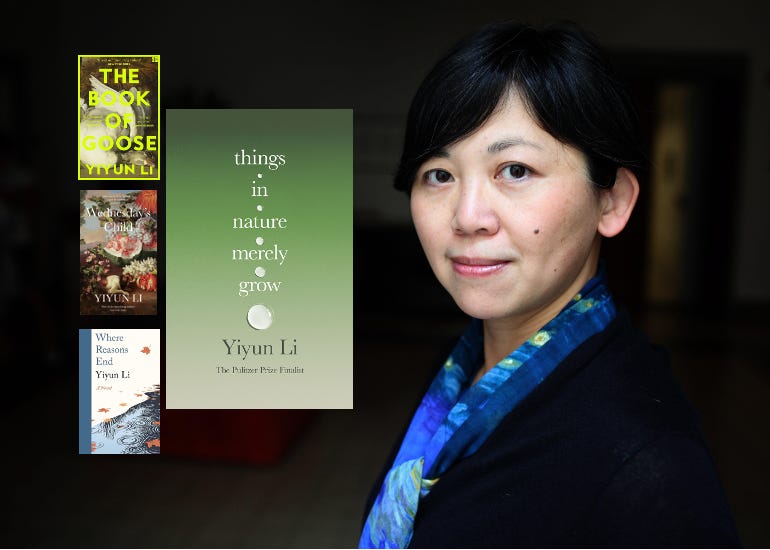
On May 20, Things in Nature Merely Grow, the latest memoir by Chinese American writer and Princeton professor Yiyun Li (李翊云), was released. It is a work of stark confrontation with pain, recounting her way of thinking and surviving after the successive losses of her two sons. “There is no good way to say this, no good way to state facts that must be acknowledged,” Li writes at the beginning. “My husband and I had two children. But we lost them: Vincent died in 2017, at sixteen; James died in 2024, at nineteen. Both took their own lives, both died not far from home.”
This 192-page memoir embodies what Li calls “radical acceptance”—not a narrative of recovery or transcendence, but a focus on living alongside death. It is her third book on the subject of suicide. Following her 2017 essay collection Dear Friend, from My Life I Write to You in Your Life and her 2019 novel Where Reasons End, this new work emerges from the 2024 suicide of her younger son James. Li is adamant: this is not a book about grief or mourning, and it offers no clean arc from pain to transcendence. Instead, she seeks words that can make space for James—through reading Camus and Wittgenstein, through learning piano, gardening, and writing.
She refuses consoling metaphors. Her language is direct, stripped of embellishment. Critics have responded with reverence. The New York Times called it “a reflection at once blunt and unrelenting—Li faces not only the pain of losing her children, but the limits of language itself.” The Guardian described it as “unsentimental to the point of austerity, and yet likely to leave you shaken by its emotional force.”
Turning Unspeakable Grief into Narrative
To articulate the unspeakable sorrow of losing a child, Yiyun Li turns to fiction and nonfiction alike, transforming grief into narratives that can be sensed and understood. In her fiction, she does not confine herself to traditional realist accounts of mourning. Instead, she dares to construct narrative spaces that blend reality and imagination. Her novel Where Reasons End is emblematic of this approach—a story in which a mother who has lost her son engages him in dialogue within a timeless, imagined realm.
Death is typically the threshold of silence, of irreparable absence. Yet Li, through the force of literary imagination, defies this finality—she “calls back the dead,” building a bridge in the space between the living and the dead, between yesterday and tomorrow, to allow a conversation that should never be possible. This impossible dialogue becomes the novel’s beating heart.
The mother and son do not simply grieve; they spar, joke, and debate in a language thick with intellect and play. They argue over the superiority of adjectives versus nouns, and invent new terms—“aftertime,” for instance, to name the span beyond death. These seemingly casual exchanges are, in truth, meditations on how they understand life and probe death. Through this meticulous breaking apart and reassembling of language, Li embeds the anguish of loss into the very grain of her prose. Readers are made to feel the tremor of irreversible absence in every wry, measured line.
If Where Reasons End gives voice to the dead through imagined dialogue, Li’s novel Must I Go employs a different narrative strategy to explore maternal grief. The protagonist, Lilia, is an 88-year-old woman in a retirement home, still carrying the hidden wound of her daughter Lucy’s suicide. Lilia reads and annotates the diaries of a deceased former lover, interlacing her private mourning with a public commentary on a life not her own.
Lilia is a sharply drawn figure: acerbic, unyielding, armored in sardonic humor to fend off the weight of her sorrow. In the margins of the diary, she scrawls fragmented memories and pointed remarks, using irony and emotional restraint as a buffer against the “bottomless sadness” of loss. As one review noted, her cool wit forms a membrane separating her from despair, guiding readers through a seemingly barren landscape of mourning with a voice that is “stubborn and impish.”
Li deftly explores how what we love, lose, and grieve can shape, fracture, and reassemble us into the people we become. Each morning, Lilia repeats to herself: “Another day Lucy refused to live.” And she counters that refusal by resolutely choosing to live—to live well, to live on. Her insistence on enduring becomes not a denial of grief, but a reframing of life itself: if love and loss are inevitable, then continuing to live becomes its own act of resistance and meaning.
In addition to fiction, Li confronts the death of her sons most directly in her nonfiction, especially in her recent essay collection Things in Nature Merely Grow. This memoir, fewer than two hundred pages, is a document of survival written from the edge of the abyss. She writes plainly: “I am in the abyss. I didn’t fall in by accident… I just, inexplicably and shockingly, found myself there.” A few unadorned words, and already one senses the immensity of despair.
But Li resists turning her prose into lament. Instead, she exhibits a near-defiant clarity of mind, reaching for books and language even in her darkest hours, striving to “use words to explain myself to myself.” She draws on philosophers and writers—Wittgenstein, Euripides, Camus, Philip Larkin—not to escape her suffering, but to find within their words a foothold for her own sorrow. When pain cannot be undone, she suggests, thought and language are all that remain.
Even the book’s title—Things in Nature Merely Grow—contains its own quiet provocation: personal devastation leaves no mark on the impassive march of nature or time. Li, frozen in pain, watches the world grow on. This is both cruelty and revelation. As one reviewer observed, perhaps we keep going only “because we have no choice.” In her stark, graceful prose, Li makes a case for this near-fatalistic perseverance. Her grief becomes not just a private wound, but a meditation on the essence of life itself.
Philosophical Reflections on Grief, Death, and Memory
Li’s work is not merely a vessel for emotional catharsis—it is also a sustained philosophical inquiry into grief, death, and the nature of memory. Her characters, confronted with separation and loss, often wrestle with questions that have no answers: What does death mean? Can the dead still feel pain? How are the living supposed to carry on under the weight of unresolvable truths?
These questions echo throughout Where Reasons End. The mother in the novel will never know what her son thought or did in the final hours before his death—a void of knowledge that becomes a permanent wound. Yet Li resists the urge to soothe this wound with false consolation. Instead, she embraces a form of wisdom akin to John Keats’s concept of “Negative Capability”—the capacity to accept uncertainty, mystery, and doubt without reaching for resolution.
In the novel, the mother chooses not to open the digital diary her son left behind. This act is not one of denial, but of radical acceptance: she recognizes that some mysteries will never be solved and learns to live alongside them. By refusing to extract a reason from the incomprehensible, she asserts a dignity in uncertainty. As one critic remarked, any book that seeks to affirm life in the wake of a child’s death must eschew wishful thinking. It must find affirmation not through sentimental illusion, but by moving through negation to a more profound understanding.
Li does just this. She neither denies the brutal truths of life nor constructs a redemptive arc. Instead, she searches for flickers of strength that can arise only through unflinching confrontation with loss.
Her meditations on language deepen this philosophical stance. Li is acutely aware of language’s limitations—yet she continues to wrestle with it, trying to push its boundaries to better hold the weight of pain. Her writing is a long struggle against emotional aphasia. Conventional words often prove inadequate to describe searing grief, and the language of mourning has become exhausted by overuse.
To counter this, Li continually experiments with new possibilities for expression. She deconstructs the clichés of grief in search of words that might feel true. In Where Reasons End, the character of Nikolai, the deceased son, repeatedly warns his mother to be wary of linguistic laziness. He mocks her reliance on adjectives and sentimental phrases, cautioning her: “Don’t protest by turning into a bad writer.” Their back-and-forth—at once witty and combative—doubles as Li’s own investigation into how to write honestly about sorrow.
This reflexivity reveals the double bind of grief: that language may be incapable of fully capturing it, and yet it is the only means we have to attempt such capture. Sometimes, Li’s characters choose silence over platitudes, sensing that inadequate words can desecrate genuine pain. But when they do speak, every utterance is deliberate, compressed, and infused with insight.
Li has said in interviews that she is drawn to the places “language cannot reach”—and indeed, much of her emotional power lies in what is left unsaid, in the silences between sentences, in the negative space of metaphor and question. In her most recent essays, she goes even further, declaring: “The abyss… is my dwelling place.” The line is almost metaphysical. The abyss becomes not just a metaphor for despair but a permanent state of being. And within it, she seeks—through language—a foothold, a space to endure.
If grief is the deepest of emotional abysses, Li inhabits it fully. She dares to ask: Can the abyss become a natural place of residence? Can pain be accepted like the color of one’s eyes or hair? These are questions without answers. And yet, they illuminate the philosophical depth that undergirds all of Li’s work. In her literary world, sorrow is never simply a private misfortune. It is a profound interrogation of the human condition. Language, for her, is both a failing bridge and a flickering torch—fragile, imperfect, and yet the only means we have to walk through darkness.
Aesthetic Clarity and the Art of Restraint
Yiyun Li’s prose is marked by a striking clarity and restraint. Her language is never ornamental, never excessive. There is a childlike seriousness to her precision—a purity that refuses to be sentimental. The beauty of her writing lies not in flourishes, but in its distilled simplicity. Every word feels considered, every sentence pared to its essential truth.
As Li herself has said, English has become her “private language.” Each word must pass through layers of contemplation before it can be set to the page. This discipline grants her work a unique texture: the surface is calm, but beneath it, emotion simmers with a controlled intensity. Her prose is deceptively quiet, like still water with great depth.
There is no softness in her love, no gentleness in her attention. Critics have called her style one of “unsentimental love” and “cruel precision.” Garth Greenwell observed that Li’s gaze upon her characters has a near-divine quality—empathetic but unpitying, compassionate without illusion. Her commitment to what he calls “the erasure of the self” in her writing allows her to approach the rawest aspects of human suffering with unmatched honesty.
In this tension between rationality and emotion, her voice achieves a remarkable balance. Her language is coolly reasoned, but within that reason lies a fierce, unflinching sorrow. In Where Reasons End, the mother and son’s conversations are laced with bite and playfulness. They quarrel over syntax and semantics, over the rightness of words. This is not idle banter. It is, in truth, Li’s language philosophy made manifest in character: a refusal to accept vagueness, a conviction that only the most precise words can bear the unbearable weight of grief.
Because of this devotion to clarity, her work exudes a quiet resonance. The emotional impact accumulates not through dramatic outpourings, but through silence, rigor, and the honest, glinting edge of well-chosen words. Her prose contains the dignity of restraint.
The Influence of Chinese American Identity on Her Work
As a writer of Chinese descent, Yiyun Li’s cultural identity and linguistic choices have profoundly shaped both the themes and forms of her work. Born and raised in Beijing, she emigrated to the United States as an adult—yet she chose to “betray” her mother tongue and write in English. For Li, English is not merely a tool of expression but a symbol of psychological autonomy.
In her youth, under the rule of a domineering mother, she lived with almost no personal privacy. To resist her mother’s habit of reading her diary, Li invented a kind of encryption system—replacing actual experiences with absurd and disconnected words, turning her Chinese diary into a private code. That early act of defiance was her first assertion of agency through language. Chinese, once her native tongue, became a battlefield of control; English, by contrast, offered refuge.
At twelve, when she first encountered English, she felt as though a door had opened into freedom. Her mother couldn’t understand this new language. English became her shield against scrutiny, her space of sovereignty. Years later, when she began to write in English, she claimed it fully as her own: “When I write, I often forget that others also use English. It is my private language. Every word must be earned before it becomes mine.”
This deeply personal relationship to language has lent her work a distinct voice, unswayed by nostalgia or the demands of cultural allegiance. She writes not out of obligation to represent, but from the desire to articulate. This freedom from the gravitational pull of “homeland narrative” has helped her carve out a fiercely individual path.
Early in her career, critics in the West attempted to categorize her as a minority writer delivering tales of “the Chinese homeland.” Her debut collection A Thousand Years of Good Prayers, with its portraits of ordinary people caught in China’s social transformations, was seen as a window into contemporary China. But Li quickly challenged this frame. Her subsequent work, with its elusive structure and metaphysical preoccupations, defied such easy classification.
She rejected both cultural stereotypes and the formulas of creative writing orthodoxy. Her life choices mirrored this resistance: walking away from a nearly completed medical degree to pursue writing; insisting on writing exclusively in English and long refusing to allow translations of her fiction into Chinese. She has said that writing is the only realm in her life wholly free from her mother’s control. To let her mother’s language re-enter her fiction would, for her, be a kind of defeat.
Until recently, when a Chinese edition of Must I Go was published, she had withheld translation rights for all her novels. That decision speaks to how jealously she guards the autonomy of her creative space. Her Chinese American identity, rather than anchoring her to familiar themes of cultural conflict or heritage, has instead deepened her interrogation of the self, language, and memory.
Perhaps it is precisely because she exists between cultures that she understands so acutely the tensions among language, identity, and memory. Writing in a second language has brought liberation—but also dislocation. English, with its neutrality, even its coldness, has at times overwritten her memories. In dreams of her childhood, family members now speak English. She has become, in a sense, “a foreigner to herself.”
But this estrangement has also granted her a unique vantage point. Her tragedies and truths transcend ethnicity. Rarely does she write directly about Chinese American identity or the anxiety of belonging. Instead, she moves at a higher register—toward themes of otherness, of solitude, of the emotional condition of being human. This, too, is the mark of an immigrant sensibility: to be simultaneously detached and deeply attuned.
Li writes in English about Chinese experience, yet her work moves beyond ethnic frameworks. Her grief is not cultural; it is universal. She occupies a singular place in American literature—not merely as a “writer of Chinese descent,” but as a writer of human depth. Her cultural position enables her to notice what others overlook, and her cross-cultural imagination lends her prose both the restraint of Eastern thought and the analytic clarity of the Western mind.
In short, Yiyun Li has turned her position between languages and cultures into a site of creative strength. Her work proves that great literature can surpass the limits of nation and language to speak to what is most deeply and enduringly human.
Writing as Witness, Writing as Survival
Yiyun Li’s literary journey is, in the deepest sense, a long and quiet rebellion: against regret, against forgetting, against death. Faced with the unimaginable sorrow of losing her children, she has not retreated into silence, nor surrendered to despair. Instead, with prose that is lucid and unflinching, she transforms “unbearable pain” into enduring language.
In both her fiction and nonfiction, whether through imagined dialogues with a lost son or through candid reflections from the brink of grief’s abyss, Li seeks meaning amid devastation. Every restrained exchange in her novels, every etched metaphor, is a deliberate act of rebuilding—laying order over the ruins of loss. Her writing illuminates the fragile dignity and resilience of the human spirit in the face of irreparable fracture.
Through her spare, exacting aesthetic and her philosophical depth, Li has expanded the way literature can write about grief and death. She reminds us that the most moving elegies are not those drowned in tears, but those that carry the quiet power of still waters—grief rendered not as spectacle, but as clarity. Her voice is that of a steady flame in darkness: small, steady, and unextinguished.
In her words, we accompany a mother through the shadowed valley of unspeakable loss, and emerge with a deeper understanding of life’s complexity and emotional resonance. What begins as a personal reckoning grows into a broader meditation on what it means to be human. Her literary work is not only an act of survival—it is also an act of witness, of defiance, and of love.
Through her writing, the lives of her sons are remembered and reanimated. They live on—not merely in memory, but in the hearts of every reader who dares to dwell, with her, in the hardest truths. Her reflections on death invite us to consider its rightful place in life—not to fear it, or to deny it, but to see in it the very structure that gives life its shape and urgency.
This, perhaps, is Li’s most enduring gift to the world of literature: the courage to speak of the unspeakable, and the wisdom to do so in words that offer no escape, but instead lead us, quietly, toward meaning. She writes not to heal, not to transcend, but to endure—and in doing so, she offers her readers the same.