
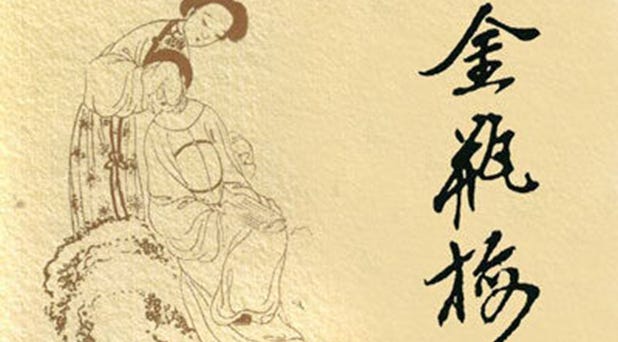
Jin Ping Mei (金瓶梅) (Chapter One)
Ximen Qing (西门庆) Warmly Binds Ten Brothers to Himself; Wu Song (武二郎) Coldly Meets His Own Brother and Sister-in-Law

The poem says:
Luxury gone, no traveler passes there;
No flute or zither sounds, and song is choked to silence.
The hero’s sword has lost its light and sinks in dimness;
The treasured lute lies broken, its golden stars gone out.
On jade steps the autumn dew falls in loneliness;
The moon still shines where once the dancers sang.
But those who sang and danced there then return no more,
And all are turned to ashes now at Xiling.
Another poem says:
A girl of sixteen, soft and supple as cream,
Wears at her waist a sword to strike down foolish men.
No head is seen to fall before your eyes,
Yet in the dark she drains the marrow from your bones.
This poem was written long ago, in the great Tang, by an immortal elder: a hero who cultivated truth and refined his nature, a mighty man who rose beyond the common world, later took his place in the Purple Mansions, entered the ranks of the immortals, and led the assembled spirits of the Upper Eight Caverns to save the suffering beings of the Four Continents. His surname was Lü, his given name Yan, and his style in religion was Patriarch Chunyang (纯阳子祖师). He spoke only of the men of this world, forever bustling and scrambling, forever in haste, yet unable to break through the passes of the seven passions and six desires, unable to escape the circle of wine, lust, wealth, and wrath. In the end they all come to ruin together. What, then, is so worth the struggle? Yet even so, among these four things—wine, lust, wealth, and wrath—it is wealth and lust that do the deepest harm. How may one see the harm they do? Suppose a man is brought so low that he has endured every misery and swallowed every bitterness. At night he feels in the rice jar and finds not enough for the next morning’s meal. At dawn he looks toward the stove and is ashamed to see not even a thread of smoke. His wife and children starve and shiver; he himself is cold and hungry. Even plain gruel is hard to come by—how much less spare coins for wine! Worse still, his kin and friends turn cold eyes upon him. His face grows lean and poor. Even the ambition that once rose to the clouds wears away. How can such a man hold up his head before others? As the saying goes:
When the horse is dead and the gold is gone,
Even kin become strangers on the road.
But when a man has money, he can scatter gold and buy smiles, spend ten thousand without a thought. If he wishes to drink, he has nectar and jade liquor, and does not count what runs through amber cups. If he wishes to swagger, money itself can move the gods, and with a mere lift of the hand he gives orders and expects obedience. Those who chase heat crowd shoulder to shoulder; those who cling to power will suck an abscess and lick a sore. So it is indeed: when a man has power, they come pressing in upon him; when he loses it, they cast him off with a swing of the arm. Of all the ugly ways of this hot-and-cold world, none is worse than that. Are not such people plainly ensnared by the harm of wealth?
Now let us speak of the harm of lust. Look at the world as it is. Men like Liuxia Hui, who could sit beside a woman and remain untouched; or the “man of Lu,” who barred his door and admitted none; or Guan Yunchang, who held the candle all night and kept his honor—how many such men have there ever been, in old times or now? As for those who keep three wives and four concubines, or buy pleasure and chase delight, that is another matter. There is also a sort of lecherous fellow who, if he sees a woman with even a little beauty, will think up a hundred tricks and a thousand schemes, sending secret warmth and stolen kindness. And once he gets his chance, he cares for nothing but that instant’s pleasure. He does not mind the claims of kinship; he does not think of friendship. At the start he has not spared a great deal of wasted money, nor skimped on wine and feasts. As the saying goes:
Three cups of wine make the match,
Two little drinks become lust’s go-betweens.
And in the end, when passion grows hot and the affair comes to light, it may even lead to violence and bloodshed. Life is lost, wife and children abandoned, a whole livelihood turned to ash. Was not Shi Jilun, rich enough to blot out the sky, ruined and imprisoned for Green Pearl? Did not Xiang Yu, whose strength could uproot mountains, come at last to grief for Yu Ji beneath Gaixia? Truly it is as the old saying has it: “The gate that gave me life becomes the door of death. One may see through it, yet still cannot endure to let it go.” Are not such men plainly ensnared by the harm of lust?
Yet for all that, these two words—wealth and lust—have never been easy for men to see through. If a man really could see through them, then heaps of gold and piles of jade would seem to him no more than broken tiles and clods of mud, things one cannot carry into the coffin. Stores of grain and strings of cash would be nothing but stinking mire and dung, more than a skin bag could ever contain. Great halls and tall mansions, jade towers and jeweled chambers—none can be raised as a pleasure pavilion upon one’s burial mound. Brocade robes and embroidered jackets, fox furs and sable cloaks—none can be wrapped about a skull like worn-out stuffing. And as for enchanting beauties, fair-faced women skilled in charm and seduction, if one sees through them, they are like generals on the battlefield, crying out and showing their might in the clash of arms. Their vermilion lips and bright white teeth, the sleeve half-lifted, the glance half-turned—once you understand them, they are no better than demon judges and night-fiends before the halls of Yama. A curved silk slipper, a three-inch golden lily—these are but the hoe and spade that break the earth when the grave is dug. The tender intimacy upon the pillow, the love beneath the quilt—these are the very life one lives in the boiling cauldron beneath the Fifth Hall of Hell. Only two lines in the Diamond Sutra (Jingang Jing, 金刚经) say it well: “Like a dream, an illusion, a bubble, a shadow; like dew, and like lightning.” Thus one sees that while a man lives in this world, there is not one thing he can do without; but when the end comes, there is not one thing he can use. Be your strength such that you can lift a tripod or stir a boat, in the end your bones will soften and your sinews go numb. Let your luxury be like the copper mountains and golden valleys—at the height of it all, it will still melt away like ice and vanish like snow. Suppose your beauty could shame the moon and outdo the flowers: once your brows droop and your eyes sink, men will pinch their noses and pass you by. Suppose your wit were like Lu Jia’s or Sui He’s: when teeth are cold and lips are numb, what then can be done? Better to cut off the six roots and keep oneself pure, throw on a single cassock, see through the world of emptiness and form, wear through the workings of birth and death, and so pass straight into the Highest Vehicle, falling into no snare of right and wrong. That way one may at least gain a little peace and ease, and not tumble headlong through the fire-pit. As the saying goes:
While three inches of breath remain, a thousand uses may be found;
One day when the summons comes, all things are done.
Why does the storyteller begin with this discourse on wine, lust, wealth, and wrath? It is because there once was such a household as this—rich and splendid at first, then pitifully wretched in the end. All its schemes and cunning, all its arts of power and calculation, proved useless in the least degree. Of its kin and friends, of its sworn brothers and companions, not one could be relied upon. It enjoyed only a few brief years of glory, yet left behind a world of gossip. And among its women were some who fought for favor, strove to outshine one another, played the wanton and sold their smiles. At first they were all coquetry and grace. In the end they could not escape lying dead beneath the lamplight, blood staining an empty chamber. So it is:
Good is repaid with good, evil with evil;
Heaven’s net is vast, and though its mesh is wide, none slips through.
Now in the reign of Emperor Huizong of the Great Song, in the Zhenghe era, there lived in Qinghe County (清河县), Dongping Prefecture (东平府), Shandong, a handsome young rake. He was broad of frame, easy in manner, and had a fair property to his name. He was some twenty-six or twenty-seven years old. His surname, made of two characters, was Ximen (西门), and his given name was Qing (庆). His father, Ximen Da (西门达), had once traveled Sichuan and Guangxi dealing in medicinal goods, and in Qinghe County (清河县) had opened a large apothecary shop. The family dwelt in a house of five bays at the front and seven courts deep. Slaves and maids answered the call indoors; mules and horses stood thick in the yard. It could not be called the greatest wealth, yet it was certainly a prosperous house in Qinghe County (清河县). But Ximen Da (西门达) and his wife died early, leaving only this one son. Because they had doted on him in every way and let him do as he pleased, he had never much studied books. All day long he idled, roamed, and drifted. Since his parents’ death, he had given himself wholly to flowers and willows, to women and the wind, to every light pursuit. He had learned a little boxing and cudgel-play, and was handy, too, at gambling, backgammon, chess, cards, and writing slips. Of the friends he kept, all were parasites and loose fellows, men with oily mouths and no proper trade.
The closest of them was named Ying Bojue (应伯爵), style Guanghou (光侯). He had once been the second son of Master Ying, who kept a silk shop. Having lost his capital and fallen low, he now spent his time haunting the licensed quarters and living off panders’ scraps, so that people had given him the nickname Ying the Beggar. He could also kick a fine ball and was skilled at backgammon and chess besides. The second was Xie Xida (谢希大), style Zichun (子纯), descended from a hereditary qianhu military household of Qinghe Guard. Fatherless and motherless from childhood, he had let his prospects slip and grown into another idle hanger-on, though he played a good pipa. These two were especially close to Ximen Qing (西门庆). The rest were all broken-down men without standing: one called Zhu Shinian (祝实念), style Gongcheng (贡诚); one called Sun Tianhua (孙天化), style Boxiu (伯修), nicknamed Sun Loose-Mouth; one called Wu Dian’en (吴典恩), once a county yin-yang clerk, dismissed for some affair, who now stood before the yamen securing bonds with petty officials, and thus came and went with Ximen Qing (西门庆); another called Yun Lishou (云理守), brother to General Yun; one called Chang Zhijie (常峙节), style Jianchu (坚初); one called Bu Zhidao (卜志道); and one called Bai Laiguang (白赉光), style Guangtang (光汤). As for Bai Laiguang (白赉光), some among the group said his name sounded ill-chosen, but he would explain it himself: “Not so. Else I’d have changed it long ago. When I was named, the old tutor of our house said that since my surname was Bai, there was a tale of the white fish leaping into King Wu’s boat. Then he cited the lines, ‘Zhou had a great gift, and to Tang there was light,’ and took the meaning from there, so my style was Guangtang. Because of that story, I’ve kept it.” There were more than ten of these men in all. Seeing that Ximen Qing (西门庆) had money in hand and spent it freely, they gathered around him in a noisy swarm, egging him on to gamble, drink, whore, and play. It is exactly as the verse says:
They raise their cups and link their goblets, full of heat and brotherly pride—
“Brother, brother,” they cry; but how close are they indeed?
Let one storm rise from level ground,
And then their hearts will plainly show.
Now mark this well: in such a household, with such a prodigal son, and such a set of friends good for nothing but harm, how could wealth, however great, fail to dwindle? What hope could there be of better days? And yet there was one reason why Ximen Qing (西门庆) still prospered. By nature he was hard and forceful, deep and tricky in his dealings. He also lent money to officials. Even with the four great traitors at court—Gao, Yang, Tong, and Cai—he had a way of greasing the path and getting influence to run in his favor. So he handled public matters in the county and took money to smooth affairs for others. Because of this, all the county feared him. As he was eldest in his line, everyone called him Great Gentleman Ximen (西门大官人). His first wife, née Chen (陈氏), had died young, leaving him only one daughter, Ximen Dajie (西门大姐), who was already promised to Chen Jingji (陈敬济), the son of Chen Hong (陈洪), kin by marriage to Commander Yang (杨提督) of the Eight Hundred Thousand Imperial Guards in Dongjing. The marriage, however, had not yet been celebrated. Since his first wife was dead and there was no one to govern the household, he had recently taken as his second principal wife the daughter of the Thousand-Household Wu (吴千户) of Qinghe Left Guard. This Madam Wu (吴氏), some twenty-five or twenty-six years of age, had been born on the fifteenth day of the eighth month. Her childhood name was Yuejie (月姐). After she was married into the Ximen (西门) household, everyone came to call her Yueniang (月娘). This Yueniang (月娘) was virtuous and capable, and before her husband’s face she complied in all things. In the women’s quarters there were also three or four maids and serving women, all of whom Ximen Qing (西门庆) had already had his way with. He had likewise struck up a hot attachment with Li Jiao’er (李娇儿), a singing girl from the pleasure quarter, and had brought her home as his second secondary wife. In South Street he also kept a place for Zhuo Diu’er (卓丢儿), called Second Sister Zhuo (卓二姐), whom he had maintained for some time and then married into the house as his third wife. But as Zhuo Diu’er (卓丢儿) was thin and delicate and forever ill, he still went roaming after winds and moons, teasing and tampering with other men’s women. So the verse says:
He sings and laughs with eastern beauties till he is drunk on crimson faces,
Then westward goes to spread a feast with jade-green cups.
A few days he lies beneath the peach-blossom boughs;
Wherever peonies bloom, there too he finds them lovely.
One day Ximen Qing (西门庆) sat idle at home and said to Wu Yueniang (吴月娘), “Today is the twenty-fifth of the ninth month. On the third day after month’s end comes the day when my brothers hold their gathering. That day we shall surely need two proper tables of good wine and food, and we ought to call in two singing girls as well, so that the brothers may sport merrily all day here at our house. You must arrange it for me.”
Wu Yueniang (吴月娘) answered, “You would do better not to speak of that lot. Which one among them has any heart in him, or any worth? They are no more than wandering ghosts and shameless corpses, forever coming to lure and drag you away. Ever since you took up with them, when have you had any home life at all? And now Zhuo Erjie (卓二姐) is so unwell. I advise you to drink less wine too.”
Ximen Qing (西门庆) said, “Other things you say may be sound enough, but what you say today I do not care to hear. According to you, there is not a good man among those brothers of mine. Yet when one needs them, not one refuses. And what is more, they handle matters very neatly. Even that fellow Xie Zichun (谢子纯) is not without sense and ability. Since things stand as they do, and we keep meeting and parting with nothing solid to show for it, why should we not, when the day comes, swear brotherhood together? Then in days to come we might have something to lean on.”
Wu Yueniang (吴月娘) took up the point and said, “Sworn brotherhood may be all very well. Only I fear that when the day comes, others will be leaning on you more than you on them. As for your leaning on another man—why, that would be like taking a puppet onto the stage and still finding it short one breath.”
Ximen Qing (西门庆) laughed and said, “If others can be made to lean on me, that is better still. Let us wait until Second Brother Ying (应二哥) comes, and then I shall speak of it with him.”
They were still talking when in came a young page, bright-browed and clear-eyed, nimble and sharp. He was Ximen Qing’s (西门庆) own body-servant, called Daian (玳安). He came forward and said, “Second Uncle Ying (应二叔) and Elder Uncle Xie (谢大叔) are outside asking to speak with Father.”
Ximen Qing (西门庆) said, “I was just speaking of them, and now here the pair of them are.”
So he went out into the hall. There sat Ying Bojue (应伯爵), wearing on his head a new black gauze cap and on his body a blue lined gauze robe, neither new nor quite old. On his feet were silk shoes and clean stockings. He had taken the upper seat. Below him sat Xie Xida (谢希大). When they saw Ximen Qing (西门庆) come out, both rose at once, hurriedly bowed, and said, “Brother, so you are at home. We have not seen you these past days.”
Ximen Qing (西门庆) invited them to sit. Tea was called for, and he said, “You fine gentlemen! For several days now my heart has been out of sorts, and I have not gone abroad. Yet not one of you has even shown the shadow of himself here.”
Bojue (伯爵) turned to Xida (希大) and said, “Did I not tell you? I said our brother would have something to say.” Then to Ximen Qing (西门庆) he said, “Brother, you are right to blame us. Even we ourselves do not know what keeps us so busy all day. Why, the two of our feet cannot keep pace with a single mouth!”
Ximen Qing (西门庆) asked, “And where have you been these last two days?”
Bojue (伯爵) said, “Yesterday I was at the Li house in the pleasure quarter looking at a little girl. She is the younger sister of Guijie (桂姐儿), who is niece to your Second Sister-in-law over here. Her name is Guijie (桂姐儿) too. I had not seen her in some time, and now she has grown so pretty I can hardly tell you. When she comes fully of age, Heaven knows what she will become! Yesterday her mother said to me again and again, ‘Second Father, do find her a fine young gentleman to take her first hairdressing.’ Most likely, brother, she will end up your piece of goods yet.”
Ximen Qing (西门庆) said, “Is that so? When I have a little leisure, I shall go and see.”
Xie Xida (谢希大) took it up and said, “Brother, if you doubt it, she truly has ten parts of beauty.”
Ximen Qing (西门庆) said, “You were at her house yesterday. And the few days before that, where were you?”
Bojue (伯爵) said, “The day before yesterday Brother Bu Zhidao (卜志道) died. We spent several days in his house helping to manage the confusion and send him out. His widow begged me more than once to present her respects to you. She said she was grateful that you had sent incense, paper money, and funeral gifts. But because they had no space to turn round in, and no proper wine and food to set before guests in the evening, she could not decently invite you to sit with them, and she felt deeply ashamed of it.”
Ximen Qing (西门庆) said, “I had heard he was unwell only a short while, and now already he is dead. Just the other day he sent me a fine Sichuan fan with real gold on it. I was thinking what to send in return by way of thanks, and now he has become a man of the other world!”
Xie Xida (谢希大) sighed and said, “Of the ten brothers in our club, one is gone already.” Then turning to Bojue (伯爵), he said, “The third day after month’s end comes round again, and that means our gathering. We shall have to trouble Great Gentleman (大官人) here once more to spend money, so that the brothers may make merry a day.”
Ximen Qing (西门庆) said, “Just so. I was only now saying the same to the people inside. We brothers meet and meet again, yet do nothing but drink and play. There is nothing solid in it. Better that we choose a temple, write out a petition, and swear ourselves brothers. Then in days to come we may support one another and have something to lean on. On that day I shall certainly have to spend some silver buying the three sacrificial beasts. As for the rest of you, each of you can contribute what share he likes. I am not levying a tax on you, but if each man gives a little to this business of sworn brotherhood, it will show some feeling.”
Bojue (伯爵) quickly said, “Brother, what you say is right. When an old wife burns incense, it cannot stand in place of an old man chanting Buddha’s name. Each man must do what his own heart can do. Only as for all of us, we are like a sore on a mouse’s tail—there is pus in it, but precious little.”
Ximen Qing (西门庆) laughed. “You strange dog of a fellow! Who wants a great deal from you? What talk is this?”
Xie Xida (谢希大) said, “There must be ten for the oath to look proper. Now that Brother Bu Zhidao (卜志道) is gone, whom shall we take to fill his place?”
Ximen Qing (西门庆) thought a moment and said, “Our neighbor next door, Second Brother Hua (花二哥), is nephew to Eunuch Hua (花太监). He spends bad money freely and is always going about in the pleasure quarter. His back court is divided from mine by only one wall, and he and I speak very well together. Why not send a servant to invite him?”
Ying Bojue (应伯爵) clapped his hands. “Would that be Hua Zixu (花子虚), the one who is keeping Wu Yin’er (吴银儿) in the quarter?”
Ximen Qing (西门庆) said, “The very same.”
Bojue (伯爵) laughed and said, “Brother, send that great officer of yours at once and fetch him in. If we make his acquaintance, there may be another wine bowl for us in time to come.”
Ximen Qing (西门庆) laughed. “You silly beggar! The mention of anything sets your greedy disease aching. All you think of is food.”
They all laughed. Then Ximen Qing (西门庆) called Daian (玳安) over and said, “Go to the Hua house next door and say to your Second Father Hua (花二爹) just this: ‘My father says that on the third day after month’s end he means to swear brotherhood with ten men, and he has sent me to invite Second Father to the gathering.’ See what he says, then come back and tell me. If your Second Father is not at home, say it to his Second Lady instead.”
Daian (玳安) answered and went.
Bojue (伯爵) then said, “On that day, shall it be here at your house, brother, or would the temple be better?”
Xida (希大) said, “There are only two places worth naming here: for the Buddhists, Yongfu Monastery (永福寺); for the Daoists, the Jade Emperor Temple (玉皇庙). Either one will do, wherever we choose.”
Ximen Qing (西门庆) said, “This matter of sworn brotherhood is not really the Buddhists’ affair, and I do not know the monks there. Better the Jade Emperor Temple (玉皇庙). I know the Daoist officer Wu (吴道官) there well enough, and the place is both spacious and quiet.”
Bojue (伯爵) took it up and said, “Brother, that is well said. I suppose the monks of Yongfu Monastery (永福寺) are thick with Brother Xie’s (谢) good wife, and that is why he recommended it.”
Xida (希大) laughed and cursed, “Old beggar! The moment we touch a serious matter, out comes your farting nonsense.”
While they were still laughing, Daian (玳安) came back and said to Ximen Qing (西门庆), “Second Father (二爹) was not at home, so I spoke to Second Lady (二娘). She was very pleased when she heard it, and said, ‘Since your father Ximen (西门爹) is willing to draw your Second Father into brotherhood, how could he fail to come? When he gets home, I shall tell him, and when the day comes I will see that he is urged to go. Present many thanks to your father.’ She also gave me two pieces of tea food.”
Ximen Qing (西门庆) said to Ying (应) and Xie (谢), “That wife of Second Brother Hua (花二哥) is a clever and pretty little woman indeed.” Then he drank another cup of tea.
The other two rose together and said, “Brother, we shall take our leave now and go tell the rest of the brothers to gather their shares. You, for your part, may go first and speak to Daoist Officer Wu (吴道官).”
Ximen Qing (西门庆) said, “I understand. I will not keep you.”
So they all went out through the great gate together. After he had gone a few steps, Ying Bojue (应伯爵) turned back and said, “That day, shall we call in singing girls?”
Ximen Qing (西门庆) said, “That may be left aside. If brothers sit talking and laughing among themselves, there is more趣味 in it.”
With that, Bojue (伯爵) raised his hand, and he and Xida (希大) went off together.
Let us not waste words. In the turning of a finger four or five days went by, and it was already the first day of the tenth month. Early that morning Ximen Qing (西门庆) was sitting in Yueniang’s (月娘) room when a newly capped young servant came in carrying a gilt-edged visiting box. He stepped forward, knocked his head once on the ground before Ximen Qing (西门庆), rose, and stood to one side, saying, “I come from the Hua house (花家). My father sends many respects to Father Ximen (西门爹). That day when Father Ximen (西门爹) sent the great servant over to invite my father, my father had gone out on business and could not receive the message in person. We hear that Father’s gathering is on the third day. My father has therefore sent me in advance with this contribution, asking Father to use it as he pleases for now. Tomorrow, when all has been spent and reckoned up, whatever share properly falls to my father, he will make up the rest.”
Ximen Qing (西门庆) picked up the sealed packet and saw written on the slip, “Contribution: one tael.” He said, “It is too much. There will be no need to add any more. Tell your father not to go elsewhere the day after tomorrow. Let him rise early and go with the others first to the temple.”
The servant replied, “I understand.”
Just as he was about to turn, Wu Yueniang (吴月娘) called him back and told the head maid Yuxiao (玉箫) to choose two steamed pastry fillings from the food basket and give them to him. She then said, “This is for your tea. When you get home, bow to your mistress for me and tell her that Lady Ximen (西门大娘) says that in a few days’ time she means to invite her over to sit half a day.”
The servant took them, knocked his head once more, answered, and went.
No sooner had the Hua servant gone out than Ying Bao (应保), from Ying Bojue’s (应伯爵) house, came in with a visiting box tucked under his arm. Daian (玳安) led him in to make his bow. After knocking his head, he said, “My father has gathered the contributions from the other fathers and sent me to deliver them. Father asks that you receive them.”
Ximen Qing (西门庆) took them out and saw that there were eight packets in all. Without opening them, he handed them over to Yueniang (月娘) and said, “You keep these. Tomorrow when we go to the temple, they can be added in when things are bought.”
Then Ying Bao (应保) was dismissed. Ximen Qing (西门庆) got up and went over to look in on Zhuo Erjie (卓二姐). He had barely gone and sat down when Yuxiao (玉箫) came to say, “Madam asks Father to come speak.”
Ximen Qing (西门庆) said, “Why did you not say so sooner?”
So he went back to the main rooms, where he found Yueniang (月娘) spreading the paper-wrapped packets before her. Pointing at them with a smile, she said, “Just look at these contributions. Only Second Brother Ying’s (应二) comes to one qian, two fen, and eight mace in silver. The rest are some three fen, some five fen, all reddish and yellowish, shining like gold. Our house has seen such silver before, no doubt. To take it would only soil one’s name. Better send it back.”
Ximen Qing (西门庆) said, “You take too much trouble. Leave it there. I shall make up whatever is wanting. What do these scraps matter?”
And saying so, he went straight on.
The next day, the second of the month, Ximen Qing (西门庆) weighed out four taels of silver and told the household servant Laixing (来兴) to buy one pig, one sheep, five or six jars of Jinhua wine, together with incense, candles, paper offerings, chickens, ducks, and other things for the altar wine. He also sealed up five mace of silver, and at once called the senior servant Laibao (来保), along with Daian (玳安) and Laixing (来兴), saying, “Take these to the Jade Emperor Temple (玉皇庙) and say to Master Wu (吴师父): ‘Our father will swear brotherhood with his brothers tomorrow, and asks Master to compose the written petition. In the evening we shall share the blessed offerings there with Master. We beg Master to prepare things in advance. Our father will come early tomorrow morning.’”
After a little while Daian (玳安) came back and reported, “They have been delivered, and Master Wu (吴师父) says he knows.”
Thus the second day passed. On the morning of the third, Ximen Qing (西门庆) rose, dressed, and washed. Then he said to Daian (玳安), “Go and invite Second Father Hua (花二爹) to come here and eat breakfast, so that we may go to the temple together. Then go on to Second Uncle Ying’s (应二叔) and tell him to hurry the rest of the brothers.”
Daian (玳安) answered and went. He had just invited Hua Zixu (花子虚) over when Ying Bojue (应伯爵) and the whole band of brothers arrived as well—the very men named earlier. At their head was Ying Bojue (应伯爵), followed by Xie Xida (谢希大), Sun Tianhua (孙天化), Zhu Shinian (祝实念), Wu Dian’en (吴典恩), Yun Lishou (云理守), Chang Zhijie (常峙节), and Bai Laiguang (白赉光). With Ximen Qing (西门庆) and Hua Zixu (花子虚), they made ten in all. On entering they all joined hands and made a round bow together.
Bojue (伯爵) said, “It is high time we were off.”
Ximen Qing (西门庆) said, “Let us at least eat breakfast first.”
Then he called, “Bring tea.” And also, “See to the dishes.”
In a little while breakfast was done. Ximen Qing (西门庆) changed his clothes, choosing a fresh and handsome set of robes and cap, and then they all went straight together to the Jade Emperor Temple (玉皇庙).
It was less than a few miles away, and from afar they could already see the temple gate, built in a most imposing style. Behold:
The halls rose lofty, the walls of the shrine stood high.
In front there stood a splayed gateway wall, all washed in red clay and ochre.
Within ran three ridged pathways, and on every side were laid white stones veined like flowing water.
The main hall blazed with gold and blue; beneath the galleries the eaves swept steep and fine.
In the center sat the solemn holy images of the Three Pure Ones;
And in the rear hall, Lord Lao, the Most High, leaned against his azure ox.
When they had entered the second court and turned through a side gate, they came to the Daoist cloister of Daoist Officer Wu (吴道官). Once inside, they saw on either side strange blossoms and jade grasses, old pines and green bamboo. Ximen Qing (西门庆) looked up and saw pasted upon the door-posts a pair of lines:
In the caverned dwelling, the years are without end;
Within this pot-heaven there is another world.
Above, three open bays formed the hall where Daoist Officer Wu (吴道官) morning and evening performed his offices. That day everything was laid out in perfect order. Hanging above was the Golden Towered Jade Emperor of Vast Heaven. On either side were ranged the star officials of the Purple Mansions, and off to the side hung the Four Great Marshals—Ma, Zhao, Wen, and Guan. Just then Daoist Officer Wu (吴道官) himself came out of the scripture hall and bent low to receive them.
The whole party of Ximen Qing (西门庆) entered. Tea had been served and done with, and all rose to look about them. Bai Laiguang (白赉光), taking Chang Zhijie (常峙节) by the hand, came around from the left. When they reached the image of Marshal Ma and saw his imposing air, his dignified face, and the three eyes painted on it, Bai Laiguang (白赉光) said to Chang Zhijie (常峙节), “Brother, what is the meaning of this? In the world today, it is best to keep one eye open and one eye shut. How can one bear to have a third eye to spot one’s flaws?”
Ying Bojue (应伯爵) heard this, came over, and said, “You fool of a brother, would it not be worse if he saw through you with even one more eye?”
They all laughed. Then Chang Zhijie (常峙节), pointing to Marshal Wen below, said, “Second Brother, this one all painted blue is queer enough too. I dare say he may be ancestor to Lu Qi.”
Bojue (伯爵) laughed and suddenly cried out, “Master Wu (吴先生), come here. I have a jest to tell you.”
Daoist Officer Wu (吴道官) really came over to listen.
Bojue (伯爵) said, “A Daoist died and came before Yama. Yama asked him, ‘What are you?’ The man said, ‘A Daoist priest.’ Yama had the register checked; it proved true, and since he had no sins, Yama let him return to life. On the road back he met a dyer’s workman whom he knew. The man asked, ‘Master, how is it you got to return?’ The Daoist said, ‘Because I am a Daoist, so they let me go back.’ The dyer remembered this, and when his own turn came before Yama, he too said he was a Daoist. Yama ordered an inspection and saw that when he stretched out his hands, both were blue. ‘Why is that?’ Yama asked. And the dyer answered in a chanting voice, ‘I have scratched the boils of Marshal Wen (温元帅).’”
At this the whole company roared with laughter.
Then they turned to the right side and saw below a red-faced image, which was Lord Guan (关帝), and above him a black-faced one, Marshal Zhao Yuantan (赵元坛元帅), beside whom a great tiger was painted. Bai Laiguang (白赉光) pointed and said, “Brother, look at that tiger. Surely it is not a vegetarian. How can it follow a man and do no harm?”
Bojue (伯爵) laughed and said, “You do not know. That tiger is only one of his personal attendants.”
Xie Xida (谢希大), hearing this, came over and stuck out his tongue. “If I had such an attendant following me, I could not manage it for even a moment. Would I not be afraid he might eat me?”
Bojue (伯爵) laughed and said to Ximen Qing (西门庆), “See how hard it is for him! He cannot bear even one attendant that wants to eat him. Yet we seven or eight, all wanting to eat you, do not frighten you to death.”
At that they all burst into loud laughter. Daoist Officer Wu (吴道官) came over and said, “You gentlemen are joking about the tiger, but as for our Qinghe County (清河县), these last days we have suffered sorely from a real one. Heaven knows how many travelers it has eaten, and even hunters—more than ten have been killed.”
Ximen Qing (西门庆) asked, “How came that about?”
Daoist Officer Wu (吴道官) said, “You gentlemen have not heard? I would not have known it myself, had not a young disciple of mine recently gone to Horizontal Sea Commandery in Cangzhou to collect some alms of money and grain from Great Gentleman Chai (柴大官人). He stayed there a full thirty-five days before returning. Now on the road from our Qinghe County (清河县) toward Cangzhou there is a ridge called Jingyang Ridge (景阳冈), and of late a white-foreheaded hanging-eyed tiger has appeared there and comes out often to eat men. Merchants and travelers find it terribly hard to pass. They must go in groups and companies. The county now has a standing reward of fifty taels for the beast, but no one can take it for nothing. Poor hunters! Heaven knows how many beating rods they have suffered on account of it.”
Bai Laiguang (白赉光) jumped up and said, “Today we swear brotherhood, and tomorrow we shall go catch it and earn ourselves some silver to spend.”
Ximen Qing (西门庆) said, “Is your life worth nothing?”
Bai Laiguang (白赉光) laughed. “If there is silver to be had, what use is life?”
All laughed together. Ying Bojue (应伯爵) said, “Let me tell you another jest. A man was seized by a tiger. His son rushed to save him and raised a knife to strike the beast. Then the man, from within the tiger’s jaws, cried out, ‘Son, mind how you chop—do not spoil the tiger’s skin!’”
At this they all laughed till the hall shook.
Just then Daoist Officer Wu (吴道官) finished setting out the sacrificial offerings and came to say, “Gentlemen, it is time to burn the paper.” Then, taking out the written petition, he said, “The document is prepared. Only, who stands first? Who second? Once I have the order, I can write down your honored names properly.”
All at once they said, “Naturally Great Gentleman Ximen (西门大官人) stands first.”
Ximen Qing (西门庆) said, “If it goes by age, Second Brother Ying (应二哥) is older than I, so he should stand first.”
Bojue (伯爵), sticking out his tongue, said, “Master, you would crush me flat! In times like these, one must rank by wealth and power. Who speaks of age? If it goes by age, there are men older than I as well. Besides, if I were eldest brother there would be two inconveniences. First, I do not match Great Gentleman (大官人) in dignity or force, and all the brothers look up to you. Second, I am already called Second Brother Ying (应二哥). If I become eldest, they must call me Elder Brother Ying (应大哥). If two men came at once, one crying ‘Second Brother Ying!’ and the other ‘Elder Brother Ying!’, to which should I answer?”
Ximen Qing (西门庆) laughed. “You fellow who pulls men’s guts in knots, you never have anything but this sort of idle chatter!”
Xie Xida (谢希大) said, “Brother, do not keep refusing.”
Ximen Qing (西门庆) made several modest demurrals, but Hua Zixu (花子虚), Ying Bojue (应伯爵), and the rest pressed him so hard that he had no choice but to become eldest brother. Second came Ying Bojue (应伯爵), third Xie Xida (谢希大), and fourth, by favor of his money, Hua Zixu (花子虚). The rest were placed in order after them. Daoist Officer Wu (吴道官) finished writing the petition. Then incense and candles were lit, and the men stood in their appointed places. Daoist Officer Wu (吴道官) spread the petition open and read aloud:
“We, the faithful men of Qinghe County (清河县), Dongping Prefecture (东平府), Shandong, in the Great Song—Ximen Qing (西门庆), Ying Bojue (应伯爵), Xie Xida (谢希大), Hua Zixu (花子虚), Sun Tianhua (孙天化), Zhu Shinian (祝念实), Yun Lishou (云理守), Wu Dian’en (吴典恩), Chang Zhijie (常峙节), Bai Laiguang (白赉光), and the rest—on this day, having bathed our hands and burned incense, respectfully petition. We have looked up to the weight of the Peach Garden brotherhood and dare humbly follow that example. We recall the deep feeling of Guan and Bao, and though our surnames differ, we desire to share one mind. Since all within the four seas may be brothers, why should men of different blood be less than flesh and bone? Therefore on this day of the Zhenghe reign, we have prepared pigs and sheep for sacrifice, together with gold offerings and ritual gifts, and have reverently come before this altar to pray. We bow before the Golden-Towered Jade Emperor of Vast Heaven, the duty gods of the five directions and the day, the city god and earth god of this county, and all spirits that pass to and fro, trusting that by this true incense all may alike behold and examine us. We humbly think upon the fact that though our births were on different days, we hope to die in one season, and that the words of our covenant may stand forever firm. In peace and joy may we share together; in hardship and falling may we support one another. We bind this fellowship that it may be always renewed. If ever we grow rich and honored, may we still remember poverty and want, so that from first to last there may be someone to rely upon. Let our affection increase day by day and month by month, and our loyalty be as high as heaven and as deep as earth. We pray that from the day of this oath forth, our friendship may know no fault; and we further ask that each man’s years be lengthened, and each household enjoy blessings without bound. In all that lies within time, may we receive your shelter and protection. This petition we respectfully submit.”
“When the reading was done, the men finished bowing before the gods, and then before the divine images they bowed to one another eight times in turn. After that the gods were dismissed, the paper money burned, and the blessed offerings taken down. Before long Daoist Officer Wu (吴道官) had already set people to carving up the pig and sheep and arranging the chickens, fish, fruit, and other dishes. Great bowls and broad platters were spread over two tables. Ximen Qing (西门庆) took the seat of honor, and the rest sat in proper order, with Daoist Officer Wu (吴道官) on a side seat to keep them company. In a little while several rounds of wine had gone by. They guessed fingers, played drinking games, joked and shouted till the hall rang. There is no need to tell it in detail. As the verse says:
Scarce had they watched the sun rise from Fusang,
When already they saw the day-chariot sink behind the hills.
Drunk, they must be helped away by other men;
Above the trees the new moon bent like a hook.
In the midst of all this hot drinking, Daian (玳安) came and whispered in Ximen Qing’s (西门庆) ear, “Madam says I am to fetch Father home. Third Madam (三娘) has had a fainting fit today, and Madam asks Father to return early.”
Ximen Qing (西门庆) at once rose and said, “It is not that I would overturn the table and spoil the席, but my third little wife is truly very ill, and I must go first.”
Hua Zixu (花子虚) said, “My road is the same as yours, brother. Let the two of us go together.”
Bojue (伯爵) said, “You two rich men are both going and leaving the rest of us behind? Brother Hua (花二哥), sit back down again.”
Ximen Qing (西门庆) said, “There is no one at his house. It is better that the two of us go together, so his wife may not grow suspicious.”
Daian (玳安) added, “When I came, Second Lady (二娘) had already told Tianfu (天福儿) to have the horse made ready.”
Then a young servant came up to Hua Zixu (花子虚) and said, “The horse is here. Madam asks Father to come home.”
So the two men rose together, thanked Daoist Officer Wu (吴道官) for his trouble, and, raising their hands to Bojue (伯爵) and the others, said, “Enjoy yourselves at ease. We are off.”
With that they went out and mounted their horses. As for the rest of those fellows, who could chew down Mount Tai and not even thank the earth for it, they remained drinking wildly in the temple. Let that pass.
Now as for Ximen Qing (西门庆), when he reached home he parted from Hua Zixu (花子虚) and went in, asking Wu Yueniang (吴月娘), “What brought on Zhuo Erjie’s (卓二姐) faintness?”
Yueniang (月娘) said, “I said it that way because I feared that, with a sick woman in the house, once you fell in with that gang again, they would drag you off somewhere else. So I told Daian (玳安) to speak as he did. In truth she has only been growing worse day by day. You ought to remain at home and look in on her.”
Ximen Qing (西门庆), hearing this, went over to see her, and for several days stayed at home in attendance. There is no need to tell of it.
Now time slips by like a gap in the wall, and before one knows it, the tenth day of the tenth month had come and gone. One day, as Ximen Qing (西门庆) was sending a servant to invite a physician to examine Zhuo Erjie’s (卓二姐) illness, he had just stepped into the hall when Ying Bojue (应伯爵) came in grinning broadly. Ximen Qing (西门庆) bowed to him and asked him to sit.
Bojue (伯爵) said, “Brother, how is my sister-in-law’s health?”
Ximen Qing (西门庆) said, “Most likely there is little hope. I do not know how it will turn.”
Then he asked, “On that former day, at what hour did you all finally break up?”
Bojue (伯爵) said, “Daoist Officer Wu (吴道官) pressed us again and again to stay. By the time we scattered, it was already deep into the second watch. We were so drunk we could hardly stand. Brother, you did better to come home early.”
Ximen Qing (西门庆) then asked, “Have you eaten?”
Bojue (伯爵), unwilling to say he had not, replied, “Brother, try and guess.”
Ximen Qing (西门庆) said, “Shall I guess that you have eaten?”
Bojue (伯爵) covered his mouth and said, “Then you have guessed wrong.”
Ximen Qing (西门庆) laughed. “Strange dog of a fellow! If you have not eaten, say you have not eaten. Why put on such airs?”
Then he told a servant, “Bring food. Second Uncle and I will eat together.”
Bojue (伯爵) laughed and said, “Indeed I have eaten already. I have only heard of a rare thing and come to tell it to you, so that we may go and see it together.”
Ximen Qing (西门庆) said, “What rare thing?”
Bojue (伯爵) said, “That tiger on Jingyang Ridge (景阳冈), the one Daoist Officer Wu (吴道官) spoke of the other day, was yesterday beaten to death with bare fists by a single man.”
Ximen Qing (西门庆) said, “There you go again with your nonsense. I do not believe it.”
Bojue (伯爵) said, “Brother, you may not believe it when told, but listen and I will tell it out in full.”
Then, with hands and feet flying, he began: how the man, whose name was Wu Song (武松), second in his family, had once gone to Great Gentleman Chai’s (柴大官人) estate in order to escape trouble; how later he fell ill there; how after he recovered he set out to find his elder brother and came by way of Jingyang Ridge (景阳冈); how he met the tiger there; how in this way and that he beat it dead with his fists and feet. He told it all, point by point, as though he had seen it with his own eyes, and indeed almost as though he himself had killed the beast.
When he was done, Ximen Qing (西门庆) shook his head and said, “If it is really so, then let us eat quickly and go have a look.”
Bojue (伯爵) said, “Brother, let us not eat, lest we miss it. Better we go sit in an upper room on the main street.”
Just then Laixing (来兴) came to set out the table. Ximen Qing (西门庆) said, “Go tell your mistress not to have the meal brought. Fetch my clothes for me to put on.”
In a little while he had changed and gone out hand in hand with Bojue (伯爵). On the road they met Xie Xida (谢希大), who laughed and said, “Brothers, are you off to see the tiger-slayer?”
Ximen Qing (西门庆) said, “That is just it.”
Xie Xida (谢希大) said, “The great street is packed too tight to stir.”
So the three of them went together to an upper chamber of a wine shop facing the street and sat there. Before long they heard the clang of gongs and the beat of drums. All looked out together. First came pairs of hunters carrying tasseled spears. Behind them was the dead tiger itself, like a great brocade sack, so heavy that four men could scarcely bear it. Last of all, mounted on a great white horse, sat a stout warrior. This was the man who had slain the tiger.
When Ximen Qing (西门庆) saw him, he bit his finger and said, “A man like that—unless he has the strength of a water buffalo weighing a thousand catties, how could he so much as move such a beast?”
These three sat there drinking and judging the sight. Let that rest for now.
Now let us speak only of what manner of man this warrior was who came in triumph. Behold:
A heroic body, stern and strong, more than seven feet in height;
A broad face, sharply cut; some twenty-four or twenty-five years of age.
His eyes stood straight and fierce; from afar they were like twin stars.
His hands when clenched and brought near seemed a pair of iron pestles.
When his toes flew up, tigers and leopards in the deep mountains lost their spirits;
When his fists came down, bears in the far valley were stripped of soul.
On his head he wore a swastika-pattern kerchief, with two silver flowers pinned in it;
On his body a blood-stained monkish jacket, with a red brocade drape cast over it.
This man was none other than the very Wu Song(武二郎) of Yanggu County (阳谷县) of whom Ying Bojue (应伯爵) had spoken. He had come to look for his elder brother, and by chance had slain the fierce tiger. For that reason the county magistrate had sent men to escort him in. At that moment the magistrate was in session. Wu Song (武松) dismounted and entered, carrying the tiger into the hall front. The magistrate, seeing what sort of figure Wu Song (武松) cut, thought to himself, “Unless he were such a man, how could he have slain so fierce a tiger?” So he called Wu Song (武松) up into the hall. When the formal audience was over, Wu Song (武松) recounted the whole matter of the tiger-slaying from beginning to end. The officials on either side were struck dumb. The magistrate bestowed upon him three cups of wine in the hall and ordered that the fifty taels of reward money, drawn from the county’s contributions, be given him.
Wu Song (武松) bowed and said, “This humble man relied upon Your Excellency’s good fortune and favor. By mere chance I was lucky enough to kill the beast. It was not through any true ability of mine. How dare I accept such a reward? Because of this animal, the hunters have suffered many punishments from Your Excellency. Why not distribute the reward among them instead? It would make Your Excellency’s kindness shine all the brighter.”
The magistrate said, “If that is your wish, then let the brave man dispose of it as he pleases.”
So Wu Song (武松) there in the hall distributed the fifty taels among the hunters. The magistrate, seeing that he was benevolent, loyal, and stout-hearted, and also a fine hero, wished to advance him. So he said, “Though you are a native of Yanggu County (阳谷县), my Qinghe County (清河县) lies only a short way off. This day I shall appoint you here as a patrol constable, charged especially with seizing bandits east of the river and west of the water. What say you to that?”
Wu Song (武松) knelt and thanked him. “If I may receive such favor from Your Excellency, I shall be grateful all my life.”
The magistrate at once summoned the clerk to draw up the papers, and that very day appointed Wu Song (武松) patrol constable. All the village headmen and great householders came to congratulate him, and for several days there was nothing but feast upon feast. He had meant to return to Yanggu County (阳谷县) to seek his elder brother, but now that he had unexpectedly become a constable in Qinghe County (清河县), he was glad enough. At that time his name was spread through one prefecture and two counties of Dongping, and all men knew of Wu Song (武松). So the verse says:
The hero’s skill and fame smelled sweet afar;
He strode straight up Jingyang Ridge (景阳冈).
Drunk, he beat the mountain tiger dead,
And from that day his name was heard on every side.
Now one day, as Wu Song (武松) was strolling idly in the street, he heard someone behind him cry out, “Brother, now that the county magistrate has raised you to be patrol constable, how is it you do not look after me?”
Wu Song (武松) turned his head and saw the man. At once—
Joy burst out at brow and eye,
And gladness leapt from smiling lips.
This man was none other than his own elder brother Wu Dalang (武大郎), whom he had long meant to seek. After the brothers had parted, there had been famine, and Wu Dalang (武大郎) had moved to Qinghe County (清河县), renting a place in Purple Stone Street (紫石街). Seeing how weak he was in spirit and how shabby his figure, people had given him the nickname “Three-Inch Ding, Bark-on-the-Valley-Tree,” meaning that his body was coarse, his face narrow, and his appearance poor. Because he was so meek and simple, people often bullied him. But that need not detain us now. Wu Dalang (武大郎) had no settled trade. Each day he carried a shoulder-pole out into the streets and sold steamed cakes for a living. Misfortune had taken his wife from him, leaving only a little daughter, not yet twelve, called Ying’er (迎儿), and father and child lived together. Within half a year he had worn away even his small capital, and moved to a room facing the street in the great house of Zhang Dahu (张大户). The Zhang household servants found him honest and dependable, and often looked after him, so that he could go on selling his cakes as before. When idle, he would sit in the shop, and in all things he showed deference. Because of that, every servant in the Zhang household liked him and put in a good word for him before the master. So Zhang Dahu (张大户) did not even ask him for rent.
Now this Zhang Dahu (张大户) possessed ten thousand strings of cash and a hundred rooms of houses. He was upward of sixty years old, yet had not a single son or daughter about him, not so much as one inch of boy or foot of girl. His wife, Yu Shi (余氏), ruled the house sternly, and there were no handsome maids in the women’s quarters. Zhang Dahu (张大户) would often thump his breast and sigh, saying, “At my age, and with no children, what use in the end is all this wealth?”
Madam Yu (余氏) said, “If that is truly your mind, I shall call a go-between and buy you two serving girls. They can be taught music and song and attend on you morning and evening.”
Zhang Dahu (张大户), hearing this, was overjoyed and thanked her. After some days Madam Yu (余氏) truly did send for a broker, and they bought two maids: one called Pan Jinlian (潘金莲), the other Bai Yulian (白玉莲). Yulian (玉莲) was sixteen years old, born of a musician household, fair and dainty in person. But this Pan Jinlian (潘金莲) was the daughter of Pan Cai (潘裁) who lived outside the South Gate, and she ranked sixth among the girls of her family. Because from childhood she had shown a little beauty, and because her feet had been bound into an especially fine pair of little feet, she was called Jinlian (金莲), “Golden Lotus.” Her father died, and her mother could no longer maintain herself, so at the age of nine she sold the child into the household of Wang Zhaoxuan (王招宣), where she was taught music and song. In idle times they also taught her to read and write. By nature she was quick, supple, and clever. Before she was even twelve or thirteen she could already paint her brows, work her eyes, powder her face, lay on rouge, play the flute and pluck the strings, sew and embroider, read and write. She dressed her hair in a coiled knot and wore a close-fitting jacket, always putting on airs and striking poses. When she reached fifteen, Wang Zhaoxuan (王招宣) died. Pan Mama (潘妈妈) then got her back and sold her on again to Zhang Dahu’s (张大户) house for thirty taels of silver. She entered at the same time as Yulian (玉莲). Zhang Dahu (张大户) had them trained in music and song. Jinlian (金莲) already knew much of it, which saved labor. Jinlian (金莲) learned the pipa; Yulian (玉莲) learned the zither. These two slept in the same room. At first the mistress, Madam Yu (余氏), favored them both and adorned them with gold and silver ornaments. Later, however, Bai Yulian (白玉莲) died unexpectedly, leaving only Jinlian (金莲). She grew to eighteen, and her face was like peach blossom, her brows like the new moon. Zhang Dahu (张大户) often wished to possess her, but the strictness of Madam Yu (余氏) kept him from his will. One day, when Madam Yu (余氏) had gone next door to a banquet and was not at home, he secretly called Jinlian (金莲) into his room and there had his way with her. As the verse says:
Do not marvel that the meeting on Mount Tiantai came late;
Liu Lang was still the same old Liu Lang after all.
From the time Zhang Dahu (张大户) took Jinlian (金莲), four or five new ailments soon appeared in his body. What were they? First, his waist began to ache. Second, his eyes began to water. Third, his ears began to fail. Fourth, his nose began to run. Fifth, his water began to drip. Once these disorders appeared, Madam Yu (余氏) more or less guessed the truth. She quarreled with Zhang Dahu (张大户) for several days and beat Jinlian (金莲) cruelly in every possible way. Zhang Dahu (张大户) knew he could no longer keep her there, and in a fit of temper even made up a dowry besides, intending to marry her off into some suitable house. The household servants all said that Wu Dalang (武大郎) was honest, had neither wife nor child, and lived already in the rooms attached to the estate, so he might do very well. Zhang Dahu (张大户), still wishing to keep an eye on the girl, therefore asked not one copper from Wu Dalang (武大郎), but married her to him outright. Since Wu Dalang (武大郎) took Jinlian (金莲), Zhang Dahu (张大户) treated him with much favor. If Wu Dalang (武大郎) lacked capital for his cake-selling, Zhang Dahu (张大户) secretly gave him silver. If Wu Dalang (武大郎) went out carrying his load, Zhang Dahu (张大户), waiting till no one saw, would slip into the room and have his tryst with Jinlian (金莲). Even if Wu Dalang (武大郎) happened to stumble upon them now and then, being but a poor dependent of his, he did not dare speak out. Morning and evening it went on so for some time. Then one day Zhang Dahu (张大户) fell sick with a chill disorder and died. Madam Yu (余氏), having learned the truth of the affair, furiously ordered the household men to drive Jinlian (金莲) and Wu Dalang (武大郎) out at once. For that reason Wu Dalang (武大郎) rented two small rooms, inner and outer, in a house belonging to a Prince Wang (王皇亲) on the west side of Purple Stone Street (紫石街), and there went on as before selling steamed cakes.
Now after Jinlian (金莲) had married Wu Dalang (武大郎), she saw that he was nothing but dull honesty, with a person mean and ugly, and she disliked him deeply. She was forever bickering with him and cursing her fate at Zhang Dahu (张大户): “Has the whole world of men come to an end, that he must marry me to such a piece of goods as this? Every day he must be led and will not go, beaten and still steps back. He knows only to guzzle wine, and where it matters most he is no more stirring than an awl or rake. In what former life did I earn such ill-luck, that I should be married to him? Bitter, bitter indeed!”
When no one was by, she would sing a tune in Shanpoyang for proof:
Think how at first my marriage was wrongly matched;
I took you for a man worth seeing.
I do not boast for myself, but how should a crow be fit to pair with phoenix?
I am true gold buried in the earth; he is but loud brass.
How can his color compare with mine?
He is only a lump of stubborn stone—what fortune has he to clasp my jade-white body?
It is like sacred fungus growing out of dung.
Whatever comes of it,
My heart will never be pleased.
Know this: I am a brick of gold;
How can mud and earth be set beside me?
Gentle reader, hear this: whenever a woman in this world has some little beauty of her own and some native quickness of mind, if she is matched to a good man, all may pass well enough. But if she is given to such a one as Wu Dalang (武大郎), then however good her temper may be, some degree of dislike can hardly be avoided. Since olden times, true beauties and worthy men have seldom been well matched. One may go to buy gold and still never meet the man who sells gold.
Each day Wu Dalang (武大郎) would go out carrying his shoulder-pole to sell cakes, and not come home till evening. Each day, after seeing him off, the woman would sit beneath the curtain cracking melon seeds and deliberately show out that pair of little golden lilies, luring the loose young blades of the street, who every day before the door played hu-bo games, made up riddles, and shouted, “What a fine piece of mutton, and how has it fallen into a dog’s mouth?” Oily words, slippery words—there was nothing they would not say. Because of this, Wu Dalang (武大郎) could no longer live securely in Purple Stone Street (紫石街) and wished to move elsewhere, so he spoke of it with his wife.
The woman said, “You thieving muddlehead, you know nothing. You rent rooms in another man’s house, with shallow chambers and thin walls. Of course troublemakers will arise. Better add a few taels of silver, find a proper place, and take two rooms on pawn for ourselves. It would give us a little standing and save us from being bullied.”
Wu Dalang (武大郎) said, “Where am I to get money enough to pawn a house?”
The woman said, “Bah! You muddy-witted creature. You call yourself a man, and yet cannot turn your hand to anything, so that your old woman must always swallow anger. If there is no silver, take my hairpins and combs and make them up into the sum. What difficulty is there in that? Later, when more money comes, we can buy them again.”
Hearing his wife speak so, Wu Dalang (武大郎) scraped together more than ten taels of silver and took on pawn a place of four rooms near the county gate, two above and two below. The upper story had two small little courtyards besides, very neat and clean.
After Wu Dalang (武大郎) moved to West Street by the county seat, he went on as before earning his living by selling steamed cakes. It so happened that on one such day he ran into his own full brother. The brothers, seeing one another, were overjoyed. At once he invited him home and brought him upstairs to sit. Then from within he called out Jinlian (金莲) to meet Wu Song (武松). He said, “The man who killed the tiger on Jingyang Ridge (景阳冈) the other day is your younger brother by marriage here. He has now newly been made a constable. He is my own full brother, born of the same mother.”
The woman stepped forward with folded hands and said, “My respects to you, Uncle.”
Wu Song (武松) bowed and knelt low.
The woman held him up and said, “Pray rise, Uncle. You overwhelm your servant.”
Wu Song (武松) said, “My duty to my sister-in-law.”
They gave way to one another a little and then bowed on equal terms and rose. After a short while the little girl Ying’er (迎儿) brought tea, and the two drank. Seeing that the woman was very妖娆 indeed, Wu Song (武松) kept only his head lowered. Before long Wu Dalang (武大郎) had food and wine prepar1ed and entertained Wu Song (武松).
In the midst of their talk Wu Dalang (武大郎) went downstairs to buy more wine and dishes, leaving the woman alone upstairs to sit with Wu Song (武松). She looked him over—his great body, stern and strong, his face straight and handsome—and thought of how he had killed the tiger, which meant that he must indeed have the strength of a thousand men. She said nothing aloud, but in her heart she thought: “Brothers born of one mother, and yet what a difference! In my house I have that little tree-stump of a man, not a full foot high, three parts human and seven parts ghost. What plague of a fate made me run upon him? But now look at Wu Song (武松), so strong and well-made. Why should I not ask him to move in with us? It seemed that whatever bond fate meant to make had its beginning here..”
So with smiles piling up on her face, she asked, “Uncle, where do you live at present? And who prepares your meals every day?”
Wu Song (武松) said, “I has only just been made constable. Every day I must answer to my superiors, and it is inconvenient to lodge elsewhere. I have taken some poor place near the county offices, and each day two local soldiers attend me and cook.”
The woman said, “Why should Uncle not move in here and live with us? Then you need not have those county soldiers cooking such nasty meals for you. If we all live as one household, then whenever morning or evening you want some broth or hot water, it will be easy. Why, I myself can set things in order for Uncle to eat, and all will be cleaner.”
Wu Song (武松) said, “Many thanks, Sister-in-law.”
The woman said again, “Unless perhaps there is an aunt elsewhere? She too might come and keep company with us.”
Wu Song (武松) said, “I has never yet married.”
The woman said, “And how many years of youth has Uncle lived?”
Wu Song (武松) said, “I have idly passed twenty-eight years.”
The woman said, “Then Uncle is three years older than I. And from where have you come this time?”
Wu Song (武松) said, “I have been living in Cangzhou for over a year. I only supposed that my brother was still in the old house. I did not know he had moved here.”
The woman said, “It is a long tale. Ever since I was married to your brother, he has been too good, and because of that people bullied him, until we had to come here. If your brother had been a man of such strength as you, Uncle, who would have dared say one wrong word?”
Wu Song (武松) said, “My elder brother has always been a man who keeps to his place. He is not like Wu Song (武松), who makes a scene.”
The woman laughed. “How backwards you speak! There is a saying: if a man has no hardness in him, he cannot long keep himself in the world. I have always been quick by nature, and I cannot think much of a man who, beaten three times, will not turn his head, and beaten four times, will only roll his whole body.”
Wu Song (武松) said, “My brother does not stir trouble, and so saves my sister-in-law worry.”
Thus, upstairs, the two spoke one line after another. A poem bears witness:
By chance the uncle and sister-in-law met like duckweed on the stream;
The fair one made the most of her graceful face.
In secret she already wished for joy between them,
And with crooked words cast her hook at Wu Song (武松).
Now Jinlian (金莲), while she sat above keeping Wu Song (武松) company, was still speaking with him when Wu Dalang (武大郎) came home with meat, vegetables, fruit, and cakes. He set them in the kitchen, came upstairs, and called, “Wife, come downstairs for a moment.”
The woman answered, “See what a man without sense you are! Uncle is sitting here with no one to keep him company, and yet you would have me leave him and go down.”
Wu Song (武松) said, “Sister-in-law, pray go if it is convenient.”
The woman said, “Why not ask Wang the old woman next door to come over and set things in order? It is not fit simply to leave us so.”
So Wu Dalang (武大郎) himself went next door and asked Wang Po (王婆) to come. She arranged everything properly, and all was then brought upstairs and set upon the table—fish, meat, fruit, vegetables, little dishes, and cakes. Presently warm wine came up as well. Wu Dalang (武大郎) bade the woman take the host’s seat, with Wu Song (武松) opposite and he himself across the side. The three sat down, and the cups were filled. Wu Dalang (武大郎) poured wine before each of them. The woman lifted her cup and said, “Uncle, do not take offense. There is nothing fit to entertain you with. Pray accept this poor cup of wine.”
Wu Song (武松) said, “I thank my sister-in-law. Pray do not speak so.”
Wu Dalang (武大郎) busied himself pouring from cup to cup, while the woman, all smiles, kept saying, “Uncle, why do you not take even one chopstick of the meat and fruit?” And she herself picked out the best pieces and passed them over. Wu Song (武松) was a straightforward man and treated her only as his own elder brother’s wife. He did not know that she had been raised as a serving girl and was skilled in all these soft little ways, nor that all this from her came from a single mind bent on luring him. As she sat next to company Wu Song (武松) and drank several cups, her two eyes stayed fixed upon his body. Wu Song (武松), unable to bear the way she looked, could only lower his head. After they had eaten and drunk a while, and the wine had run low, he got to his feet.
Wu Dalang (武大郎) said, “Second Brother (二哥), as you have nothing to do, drink a few cups more.”
Wu Song (武松) said, “You honor me too much. I shall come again to visit my brother and sister-in-law.”
All of them went downstairs to see him out. Once they were outside the door, the woman said, “Uncle, you must truly take it to heart and move in with us. If you do not, the two of us shall only be laughed at by others. A real brother is not like some stranger. If you stand with us and help us keep our face, that too is a good thing.”
Wu Song (武松) said, “Since my sister-in-law is so kind, I shall bring my baggage over tonight.”
The woman said, “Your servant will wait here for you.”
As the verse says:
The wild spring feeling spread before them, though none there knew it;
A few peach blossoms opened of themselves in green boughs.