
Duyou Sword (杜邮剑)
—The Sorrow of Bai Qi (白起之殇)

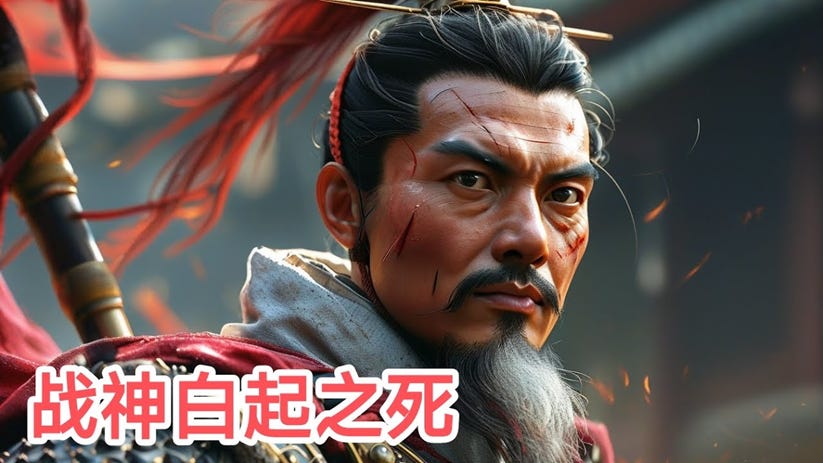
Pan Ziyi (潘子义)
The winds of the Warring States ran high; even the grass and trees smelled of blood.
Mountains and rivers lay like a chessboard under a darkening sky.
For a hundred years, men’s affairs were remade at sword’s edge.
Then one royal order sent a man on the road at once.
He had mastered every calculation that wins a war.
He could read the enemy through, yet knew too little of the human heart.
By Duyou Pavilion, the west wind blew cold,
still carrying the cry of ten thousand bones at Changping.
This was the age of the Warring States, when the seven powers fought for supremacy and no day was ever still. One day, one state took a city; the next, another wiped out an army. The smoke of battle never cleared, and the schemes of the court never ceased. After the reforms of Shang Yang (商鞅), Qin grew stronger in arms and harsher in law. This western state was slowly taking on the shape of a power that meant to swallow the realm whole. Qin had many generals whose names shook the world. But if one speaks of the man whose campaigns were the bloodiest, whose military merit stood highest, and whose name made the six eastern states blanch, that man was Lord Wu’an, Bai Qi (白起).
Bai Qi was a man of Mei County (郿县). He did not come from a great house. He had no ancestral protection behind him, no powerful clan at his back. He rose out of the ranks with nothing but a hard will and ruthless hands. Qin law prized military merit above all. Heads taken in battle were counted by grade, and those grades brought rank. Other men advanced one step at a time. Bai Qi rose a rank by stepping through blood. Men in the army used to say in private, “This Bai Qi has blades in his eyes and scales in his heart. When he fights, he does not seem human. He seems like some spirit sent to collect lives.”
The words were rough. They were not wrong.
When Bai Qi was young, he was not a man of many words. When others rested in camp, he studied maps. When others drank, he asked about grain routes. When others argued over who was brave and who was timid, he kept his eyes on the lay of the land and the ease or danger of the passes. At first, the officers noticed only that he was steady. They did not think much of him. Then a few small battles came and went. Every judgment he made proved right. Every move he made brought victory. Only then did the others begin to submit to him.
Once, an old officer in camp asked him, “Bai Qi, what is the one thing that matters most in war?”
Bai Qi answered in an even voice. “Calculation.”
The old officer asked again, “Calculation of what?”
Bai Qi said, “The ground, the grain, the roads, the enemy, and the points where men’s hearts begin to waver. If you settle victory and defeat before the blade comes out, fewer of your own men will bleed.”
The old officer nodded and sighed. “This is no crude field commander. This is a man who could swallow the world.”
Later, Bai Qi served as Left Commoner Commander (左庶长). At Yique (伊阙), he attacked Han and Wei and broke their allied forces in a great victory. That battle made his name. After that he campaigned against Chu, took Ying (郢), and burned Yiling (夷陵). The people of Chu heard Bai Qi’s name the way men hear of tigers and wolves. Then he fought at Huayang (华阳) and crushed the troops of Wei and Zhao. For decades, whenever Qin marched east, Bai Qi was almost always at the front. He did not merely know how to fight. He dared to fight. And he knew when to move fast, when to slow down, when to trap, and when to kill. Qin’s king loved to use a general like that. The men in the army trusted him. The world, though, feared him deeply.
For a time, in the six states east of the mountains, even parents trying to scare a child into sleep would say, “Hush now, or Bai Qi will come.” It is like the way Uyghur families in Xinjiang used to scare children with the warning, “Wang Huzi (王胡子) is coming.” It was a joke, but it showed the force of his name.
Still, what the world fears most is not that a man has talent. It is that he has too much. Bai Qi’s fame rose higher and higher, and his merit grew heavier and heavier. He may not have noticed. But in other people’s hearts, that small hidden thorn was sinking deeper all the time.
I. The Battle of Changping, and the Prestige of Lord Wu’an
Now to the matter itself. Zhao and Qin had been locked against each other for years, each hating the other to the bone. At Changping (长平), the fate of both states went into the balance. At first, Zhao’s general Lian Po (廉颇) fortified his position and refused to come out. Qin could not break through. When Qin saw that a long war was bringing no result, it turned to stratagem. Zhao’s king fell for a scheme of misinformation, removed Lian Po, and replaced him with Zhao Kuo (赵括). Zhao Kuo had read military books until he could speak of war in dazzling patterns. But what he said and what he could do were two different things.
When the king of Qin heard the news, he was overjoyed. In secret, he sent Bai Qi to replace Wang He (王龁) as commander, and he issued strict orders that no word of it was to get out in the army. Once Bai Qi took command, he did not beat the drums when he entered camp. He first surveyed the terrain, then the Zhao encampment, then the weather and the season. That night, the lamps in his tent burned small and low. The generals sat in rows. Bai Qi said nothing for a long time. He stared at the map, then finally drew a finger across it.
“The Zhao army can be broken.”
The generals came alive at once. As one, they asked, “How?”
Bai Qi said, “Zhao Kuo is eager for battle. He likes to press forward. We need only fight him lightly, draw him deep, cut off his grain behind him, and split his camps so that head and tail cannot answer one another. An army may be large, but once its belly is empty, it turns into decoration.”
A deputy general said, “The Zhao have hundreds of thousands of men. If we surround them and they do not die, what if they strike back?”
Bai Qi answered coldly, “A starving man may be brave for a while. A desperate man throws an army into chaos. What matters is not whether he fights for his life. What matters is whether he still has hope. Take away that last scrap of hope, and the whole army comes apart on its own.”
The men in the tent felt a chill run through them. Someone thought in silence: this Lord Wu’an calculates the enemy down to the bone.
So Bai Qi acted on the plan. He feigned retreat to draw Zhao in, then split his forces to cut the roads behind them. Zhao Kuo trusted in his greater numbers and drove his troops forward, hoping to smash the Qin camp in one stroke. Instead, he went farther and farther in. When he finally turned back, the road home had been cut and the grain route was gone. Qin then raised fortifications on all sides and tightened the circle layer by layer, trapping the Zhao army out in the open. More than forty days passed. The Zhao troops ran out of food. Men ate one another. Zhao Kuo tried again and again to break out, but in the end he was shot dead in a storm of arrows. Once the commander was dead, the whole army lost heart. Countless men surrendered.
That day, cheers shook the Qin camp. Officers and generals said, “With this victory, Zhao’s backbone is broken.”
But Bai Qi stood on high ground and watched the endless lines of surrendered soldiers. There was almost no joy on his face.
A deputy came up and said, “Lord Wu’an, this great victory is merit such as no one has ever seen!”
Bai Qi did not answer the praise. He asked only, “How many surrendered?”
“Several hundred thousand,” the deputy said.
Bai Qi asked again, “Do we have enough grain? Enough camp space? Can they be guarded?”
The deputy had no answer.
Bai Qi was silent for a long while. Then a cold light flashed in his eyes. “The hatred between Zhao and Qin runs deep. If we let them go home, they become an army again as soon as they turn around. If we disperse them under guard, too few men cannot hold them, and too many men will dull our own force. Keep them, and they are a danger. Release them, and they are a danger.”
The deputy lowered his voice. “Then Your Lordship means…”
Bai Qi raised a hand and stopped him. “In affairs of state and war, there are times when only the harshest road can be taken.”
The camp wind swept through. Banners snapped hard in the air. In the distance, the surrendered soldiers formed a dark mass, like grass spread across a barren autumn plain. Bai Qi looked toward them with neither grief nor rage on his face, only a terrible calm. It was not the pleasure of a butcher. It was the mind of a man balancing accounts, a man who, at the end, accepts only the easiest entry to clear.
What followed, the histories record in cold strokes. But the valley that night, the surrendering troops driven in their masses, and the cries that were crushed down only to rise again—none of that can ever be contained in a few written lines.
Even in the Qin army, some could not bear the sight. A young commandant whispered to an older general, “If this is done, will Heaven not punish it someday?”
The old general sighed. “A man who fights first fears defeat, then fears death, and at last has no room left even for fear. But this is a heavy account. I doubt it can be borne.”
Bai Qi knew, of course, that it was heavy. But he also knew that by military logic it was an account that had to be entered. And so the killing of the surrendered troops was done. Zhao was broken in that defeat, and the people of Zhao came to hate Bai Qi without measure. The lords of the other states heard of it too, and they felt their hearts tighten: if Qin could be this ruthless, then sooner or later the six states would all be in its turn.
With Changping, Bai Qi drove his name to its highest point. He also drove himself to the edge of the cliff.
II. At the Peak of Glory, Disaster Comes With It
After Changping, all Qin rejoiced, court and country alike. King Zhaoxiang of Qin (秦昭襄王) was especially flushed with triumph. Zhao, he thought, was already ruined. If Qin pressed on and took Handan (邯郸), the destruction of Zhao would only be a matter of days. Most of the court agreed. Some said, “Zhao’s main force is gone. If not now, when?” Others said, “Once Lord Wu’an takes the field, who in the world can stand against him?”
Bai Qi did not see it that way.
That night, he sat alone under the lamp in his tent, and even his tea went cold. He understood the matter very clearly. Zhao had lost badly, yes, but Qin had suffered too. The victory at Changping had been too fierce. Qin’s strength had been spent with it. More than that, Handan, the capital of Zhao, was nothing like a field battle. To attack a defended city far from home was another matter entirely. If the eastern lords came to Zhao’s aid at the news, Qin would find itself caught in a war abroad while already worn down at home.
The next day in court, the king of Qin asked, “Lord Wu’an, I mean to attack Handan again. Can it be done?”
All the ministers looked at Bai Qi. Bai Qi bowed with hands joined and said, “It cannot.”
The hall fell quiet.
The king frowned. “Why not?”
Bai Qi said, “Though Changping was a victory, Qin’s army is tired. Zhao is badly hurt, but its people can still be used. An army in the field is not the same as a capital fighting to the death. And now the lords all fear Qin. If Handan is besieged too long, Chu, Wei, and Han will surely come to rescue it. Then enemy forces will close from outside, and grain within will fail. Our chances grow thin.”
He spoke with perfect bluntness. He did not soften a word. When the king heard him, his face had already darkened. Fan Ju (范雎), standing nearby with lowered eyes, marked every sentence in silence.
After the audience, Fan Ju stopped Bai Qi in the corridor and said with a smile, “What Lord Wu’an said was certainly the sober judgment of a seasoned soldier. But His Majesty is in high spirits. That ‘cannot’ was put rather too hard.”
Bai Qi said, “If it can be fought, then say it can. If it cannot, then say it cannot. These are matters of war and state. How can one speak just to please the ear?”
Fan Ju’s smile did not move. “The principle is sound. But principles must be spoken with regard to the person hearing them. Your Lordship is so used to the army that perhaps you have forgotten the palace hall is not the camp.”
Bai Qi looked at him once and said, “If the Marquis Ying (应侯) has a better plan, he may present it. Bai Qi is responsible for troops, not for other things.”
Fan Ju had been given an answer that was neither soft nor hard, and inwardly he smiled a cold smile. Outwardly, though, he remained perfectly calm. “Your Lordship is frank indeed. A true pillar of the state.”
After Bai Qi left, Fan Ju curled the fingers in his sleeve very slightly and murmured, “If a pillar stands too high, it blocks the light.”
Since ancient times, what great servants fear most is not having no merit. It is having too much. And what they fear most is not public blame. It is the suspicion of the ruler. Bai Qi, unfortunately, had arrived at both at once.
Before long, the king of Qin did in fact send Wang Ling (王陵) to attack Handan. Wang Ling fared poorly and suffered grave losses. Then the king thought again of Bai Qi and ordered him to take command. The royal envoy came to Lord Wu’an’s residence and found Bai Qi pale-faced and visibly ill. After delivering the order, the envoy said, “His Majesty commands that Lord Wu’an assemble the army at once.”
Bai Qi leaned against his couch and slowly shook his head. “Illness makes it impossible. And this campaign cannot succeed. If I go, it will still end in defeat.”
The envoy said, “His Majesty says that besides Lord Wu’an, Qin has no general fit to bear such a charge.”
Bai Qi gave a bitter little smile. “That is exactly why I cannot go. To know a battle cannot be won and still go out to fight it—that is not loyalty. That is stupidity.”
The envoy said anxiously, “If Your Lordship refuses, His Majesty will be angry.”
“Then let him be angry,” Bai Qi said. “Better that one minister should bear a king’s anger than a whole state should break its army.”
The envoy had nothing to say to that and went back with the reply.
When the king heard it, he was displeased, exactly as one would expect. The first refusal could still be called caution. The second refusal was harder to excuse. By the third, the king had lost face altogether.
Once, after hearing of another defeat at the front, Bai Qi sighed to those around him, “Had they listened to my advice that day, it would not have come to this. And now? What can be done now?”
It was a bitter thing to say, but it was also true. The trouble is that many disasters in this world grow out of true words. Once that remark reached the ears of the king, he struck his desk in fury. “So Lord Wu’an thinks so highly of himself that he has come to this!”
Fan Ju, standing at the side, added softly, “Lord Wu’an’s military skill is indeed great. But men of great merit often grow high in spirit as well. I fear that in his heart it is more than mere unwillingness to lead the army.”
At that, the king’s anger rose higher still. What a ruler fears most is not an incapable minister. It is a capable one who will not serve when called, and worse, one who stands aside and watches with cold eyes. Did Bai Qi not understand this? Perhaps he did, perhaps not. He simply trusted too much in that soldier’s logic of his own, the belief that right was right and wrong was wrong. But in court, many things are not judged by right and wrong alone. Face matters. Position matters. Who stands over whom matters.
Bai Qi understood Handan. He understood the feudal lords. But he treated too lightly the most deadly human truth of all.
III. Three Refusals, and the Road to Ruin
After Wang Ling’s defeat, the king of Qin brooded on the matter and grew angrier still. At last he gave the order: Bai Qi was stripped of his rank and title, reduced to common soldier status, and exiled to Yinmi (阴密). When the edict reached his residence, Bai Qi listened to it quietly. There was no burst of outrage in him.
An old servant of the house fell to his knees and wept. “My lord has won such great merit for Qin, and now it ends like this. Where is Heaven’s justice?”
Bai Qi motioned for him to rise and said flatly, “When Yique was won and Ying of Chu fell, all the world said Heaven stood with Qin. Now that it has turned upon one man, they ask where Heaven is. If Heaven truly stepped forward for people, there would not be so many wronged spirits in the world.”
When he finished speaking, he himself seemed to start a little. This man, who had always cared only for military force, had of late found the words “wronged spirits” coming into his mind again and again. Perhaps illness had weakened him. Perhaps a man near the end softens in ways he never expects. But however much he softened, it was too late.
At first Bai Qi dragged his feet and would not leave. It was not that he clung to office. He was sick in body, and there was bitterness in him too. Other people saw a great servant cast down. Bai Qi, seeing himself, looked like a man who had kept his accounts with too much precision and had only at the end discovered the largest account of all—the one he had never entered.
A few days later, the dispatches from the front became urgent again. When the king learned that Bai Qi was still in Xianyang (咸阳), he took it as yet another sign of grievance and defiance. At once he issued a final hard order and demanded that Bai Qi leave the capital immediately.
The morning he departed was overcast, and there was a raw chill in the wind. Bai Qi left through the west gate of Xianyang with a light carriage and only a few attendants. The Lord Wu’an who had once overawed the six states still wore his robes in order, but his body had grown thin. People along the roadside watched from a distance and did not dare speak loudly. An old man sighed and said, “A man like this fought for Qin all his life, and at the end he could not even keep a decent fate.”
Someone beside him answered, “A general who knows only how to fight and not how to bow his head often ends that way.”
The old man shook his head. “Those who bow their heads do not always live well. But those who never bow usually die faster.”
The rest of the road passed in silence. Bai Qi sat in the carriage with his eyes closed and said nothing. The wind kept lifting the curtain, and each gust made his face look paler. Then, in a low voice, he asked those beside him, “Where are we now?”
One of the attendants answered, “Duyou (杜邮) lies just ahead.”
Bai Qi gave a small nod and said nothing more.
Outside Duyou Pavilion, the grass and trees were sparse and dry. The carriage had scarcely come to a stop when dust stirred behind them and a rider came up fast. The envoy dismounted, holding a long case in both hands, his face tight with fear. The attendants saw it and felt their hearts sink at once.
The envoy stepped forward, his voice trembling. “By the king’s command, a sword is bestowed upon Lord Wu’an.”
The moment those words were spoken, everything fell dead still. Even the wind seemed to stop for an instant.
Bai Qi looked at the case and did not move for a long time. At last he reached out, took it, and slowly opened it. Inside lay a sword, its light cold and sharp. It was the king’s command. It was also the command to die.
One of the attendants threw himself to the ground and burst into tears. “What crime has my lord committed, that it should come to this?”
The envoy did not dare lift his head. “The king has ordered it. Your servant does not dare say more.”
Bai Qi took the hilt in his hand, suddenly raised his head to the sky, and let out a long sigh. “What offense against Heaven has brought me to this?”
The cry was not loud, but it stretched out and out, as if it had been drawn from decades of slaughter one breath at a time. When it was over, he stood before the pavilion in silence for a very long while. The fields were empty, the far hills dark and heavy, as though countless shadows were standing in the wind and watching him.
Then he gave a brief smile, bitter beyond words. “If one says I am guiltless, that is not so either. At Changping, hundreds of thousands of Zhao soldiers surrendered, and all were buried alive. That alone is enough to warrant death.”
Those around him were shaken. No one dared answer.
Bai Qi had rarely spoken softly in his life, and he had never been given to self-reproach. Now, saying this, he seemed both to settle the account and to awaken to it. A man at the edge of the end will sometimes allow himself to look, at last, at the things he has long refused to see.
And yet even that look was not enough. Another voice in him asked coldly: if there had been no slaughter at Changping, would he have lived? Probably not. The killing of surrendered troops was one bloody debt. The suspicion of the court was another. Was the king’s sword given because of those hundreds of thousands of Zhao soldiers? Not entirely. More than that, it came from fear of Bai Qi’s merit, resentment at his refusals, and anger at his words that “the king would not heed his minister’s counsel.”
At that thought, Bai Qi’s mouth moved, as if he might smile. He did not.
Slowly, he began to understand. All his life, he had calculated and calculated. He had calculated the battlefield correctly and the court incorrectly. He had foreseen that Zhao’s army would fall. He had foreseen that Handan could not be taken. But he had never fully grasped what a king most fears, or what a colleague most resents.
He thought: why can the king of Qin not bear a single true word?
Then another thought followed: if a king could truly bear such a word, then he would not be a king.
He thought again: why did Fan Ju always add his little stings?
And then he answered himself: when had Bai Qi ever once left the man any room to retreat with dignity?
The more he thought, the colder his heart became.
The bitterest thing for a man is not to be harmed by others. It is to realize, at the very end, that the hand reaching for his throat found its opening in part because he himself had created it, year after year.
Bai Qi turned slowly and looked back in the direction of Xianyang. In that city lay the merit of his life, and the disaster of his life too.
In a low voice he said, “In those days, when I cut down enemy generals and took cities, I thought Qin used men by merit alone. Now I see that merit is weighed when a man is used, and weighed again when he is not. The greater the merit, the more it hurts the eye.”
An attendant cried, “My lord, why not defend yourself?”
Bai Qi shook his head. “Defend what? At this point, one may explain military affairs clearly enough, and still never explain the heart.”
Another attendant, still weeping, said, “If Lord Wu’an had taken command and captured Handan, matters today might not be so.”
Bai Qi answered in a hard voice, “It could not have been taken. If I had forced the attack, the end would only have been uglier. It is only this: I spoke the right words, but I should not have spoken them so hard. I saw the truth, but I should not have left others no face. Ah. The art of war teaches a man how to break an enemy. It does not teach him how to serve his ruler.”
Once the words were out, even he seemed startled by them. After decades of war, to understand this only at Duyou Pavilion—it was much too late.
IV. One Sword at Duyou, and the End of a Great Name
The envoy stood nearby, sweating coldly. The king’s order could not be defied. Before him stood the greatest general of the age. He was afraid, and ashamed too. All he could do was urge once more, “Lord Wu’an…”
Bai Qi lifted a hand and stopped him. Then he drew the sword. Its cold flash made his face look even whiter.
All at once he remembered the days of his youth, when he had first taken a sword into battle. In those years, the blade pointed outward, and it was other men it cut. Today, with the sword laid across his own neck, he understood that no one goes forward forever.
He thought again of Changping. The valley there had been windless, the soil red. When the Zhao soldiers were driven into the ravines, there had been old men among them, and boys, and men cursing Qin, and men begging for mercy. Back then, Bai Qi had seen them only as a danger, a future danger, a column of numbers that had to be wiped from the ledger after war. Here at Duyou, he felt at last that each of them had had a name, and parents, and wives and children too.
But the thought came only as a flash. He was still Bai Qi, after all. He would not spend the final moment sobbing and repenting without end. Even his regret had iron in it. A crack had opened in the stone, but the stone was still stone.
So he straightened his robes and cap and said to the envoy, “Go back and tell His Majesty that Bai Qi knows his crime.”
He paused, then added, “And knows his fate.”
Those three words carried the deepest bitterness of all.
Then he lifted the sword to his throat and cut. Blood splashed before the pavilion. Lord Wu’an was dead.
The wind moved over Duyou. The grass bent low, as if prostrate. The attendants wailed. The envoy lost his voice. On that day, the man in Qin who best understood war died by the order of his own king. If the world were to hear it, each state would no doubt let out its own sigh.
Later generations have often spoken of Bai Qi in only two ways. Some call him a god of war, victorious in every campaign. Others call him a god of slaughter, his hands stained with too much blood. Neither judgment is wholly wrong. Yet both are too shallow.
The deepest tragedy in Bai Qi lies not simply in how many men he killed, nor only in how grimly he died. It lies in this: he carried the art of war to its furthest edge, but learned far too little of the way a minister survives. On the battlefield, he could see too far. In court, he saw too narrowly. He knew when to encircle a city, when to cut supply lines, when to lure an enemy in, and when to tighten the net. But he did not know when to step back, when to soften a sentence, or when to let the king feel that the victory remained the king’s victory and the right remained the king’s right.
There are people in this world who truly possess towering gifts. But a talent sharpened too keenly is like a blade. It can wound the enemy, and it can slice the hand that holds it. Bai Qi spent a lifetime honing his knife until the whole world feared it—until the king of Qin feared it too.
Now take the king’s side. Did King Zhaoxiang not know that Bai Qi could fight? Of course he knew. Did he not know that Bai Qi’s judgment was sound? In all likelihood, he knew that too. But a ruler keeps another ledger in his heart. If Bai Qi was right at every turn, did that not make the king appear wrong at every turn? If Bai Qi’s merit grew too great and the army gave him its full allegiance, did that not cast a minister’s shadow beside the ruler’s seat? This was not a military ledger. It was the ledger of ruler and servant. Yet Bai Qi spent his whole life trying to calculate a ruler with military logic. No wonder the risk only grew.
And there was Fan Ju. Historians differ on how far he personally drove Bai Qi to death. But whatever one says, there is no doubt that Bai Qi and Fan Ju were at odds. Bai Qi cared only for victory and defeat. He was not a man who left colleagues much room or much grace. Fan Ju’s eyes, on the other hand, were fixed not only on the state but on power. Put two such men in one place, and sparks must come sooner or later. When the sparks were small, Bai Qi paid them no attention. By the time they became flame, it was too late.
So Bai Qi’s death may outwardly have come by one sword at Duyou. In truth, he died in three places.
First, he died at Changping. Those hundreds of thousands of surrendered soldiers formed a blood debt too heavy for Heaven and earth to bear.
Next, he died at Handan. His judgment of the military situation was right, but he spoke too bluntly and refused too hard.
At the end, he died in himself. He had too much merit and did not know how to draw himself in. He saw the truth and did not know how to turn with it. That was the pit he dug for himself.
V. A Blood Debt Across the Ages—Who Will Settle It?
After Duyou Pavilion, Bai Qi was dead, but the aftershock did not end. Some people in Qin pitied his service. Some feared the memory of his name. When the people of Zhao heard the news, many no doubt clapped their hands in satisfaction and called it just retribution. But if one thinks on it carefully, even the word retribution does not entirely explain what happened here.
If Bai Qi was merely evil, why was he the one who saw the Handan question most clearly? If he was merely loyal, how can one account for the blood at Changping? If the king of Qin was merely cruel, then would some other ruler, faced with a general of such towering merit who had refused command three times, necessarily have slept in peace? If Fan Ju was merely a petty villain, did Bai Qi himself ever leave anyone room to turn around with dignity?
Once one thinks in that way, one begins to see that the hardest thing in history is not dividing men neatly into black and white. It is understanding that men are often ruined not by one thing, but by a string of things that each seem to make sense on their own. Bai Qi walked all the way to Duyou step by step, and each step had its reason. Each step also brought him one inch closer to the end.
Reader, this is what it means to calculate war to the last detail and still fail to calculate men; to win the battle and still lose one’s life.
If one says that the sword at Duyou Pavilion was only the king’s sword, that is not quite true. It was also forged from the wronged spirits in the valley of Changping, from the dispute beneath the walls of Handan, from suspicion in the court, from the cold smile inside Fan Ju’s sleeve, and from the unbending hardness in Bai Qi’s own heart. These things came together and were sharpened into a single blade.
After Bai Qi’s death, the wind kept blowing as before, the roads stayed open as before, and the wheels of Qin did not stop. Some years later, Qin did indeed swallow the six states. But the blood of Changping and the sword of Duyou remained in the minds of those who came after, warning them of one thing: the world cannot be won by victory alone, and it cannot be held by ruthlessness alone. If one kills too completely, Heaven may not answer at once, but human hearts will settle the account sooner or later. If one calculates too finely, one may reckon out a single campaign and still fail to reckon out a whole life.
Bai Qi’s life leaves behind one lesson:
The people who know how to finish well are not always the strongest.
And the people who know how to wage war are not always the ones who live to the end.
The men who truly die in peace are often not the ones who charge hardest. More often, they are the ones who know how to advance and how to retreat; how to win and how to yield; how to read the situation through and still leave face to others. Bai Qi was not that kind of man. He was like a spear too straight. It was perfect for punching through enemy lines. It was also easy to snap first once it was no longer needed.
A thousand years later, the name of Lord Wu’an can still make the heart tighten. One may call him worthy of respect, and that would be fair. One may call him terrifying, and that too would be true. But to call him tragic—that is truest of all.
Because this was a man who spent his whole life calculating other people into death, and only at the end did it become his turn, when he finally entered his own life into the account.
Pan Ziyi says:
Bai Qi was a first-rate general of the Warring States. In the use of troops, his design was deep and his methods close-grained. In attack and defense, in movement and change, few could match him. Yet in the matter of his end, his merit was too great and drew his ruler’s suspicion; his words were too direct and disaster came quickly. In that too he stands as a warning to great servants across the ages. The killing at Changping may have been a harsh expedient of war, but it violated the harmony of Heaven. His refusal over Handan showed sober and far-seeing judgment, but it also ran against the ruler’s will. So his death came not only from the king of Qin’s sword. It also came from that hardness in his own nature that never learned to bend.
The ancients said that the finest commander wins where victory is easiest. Bai Qi could defeat the armies of six states, yet he could not prevail over the court of one. He could break Zhao Kuo’s forces, yet he could not break through the invisible wall between ruler and minister. This is what it means to have wisdom enough to know the enemy, but not enough to preserve oneself; courage enough to win merit, but not enough to keep one’s end secure. When one comes to the scene at Duyou, one should not only lament his wrong or condemn his cruelty. The true cause for lament is this: if a man sees the whole world only as a chessboard, sooner or later he will place himself on it too.